At a Glance
Avionté’s API-first, AI-native platform powers integrations that solve real daily challenges: scaling candidate interviews, surfacing call coaching insights, and automating timecard data entry.
3 Ways Avionté’s AI-Driven Integrations Help Staffing Firms Work Smarter
There’s no shortage of noise around AI in staffing right now. Agencies are hearing the same message everywhere: adopt AI immediately or risk being left behind. But rushing to buy AI tools without a clear problem to solve is one of the fastest ways to waste budget, frustrate your team, and end up with data you can’t rely on.
The better question isn’t, “How do we get AI?” It’s, “What challenges are we actually trying to solve, and which tools are built to solve them?” That shift in thinking changes the conversation. Instead of chasing technology for its own sake, you focus on solutions that meaningfully improve how your team works and deliver results you can measure.
As Dan Mori, President of Staffing Mastery, states in an interview with Staffing Hub:
“The companies getting out in front of it [AI] are taking a slower, more methodical approach. They’re saying, ‘Let’s not try to do everything at once. What’s the most important thing we need to address right now?’ Then, collectively as a team, they identify the best tactic and define what success looks like. They’re doing it one big rock at a time. That’s actually creating more traction and momentum. They’re slowing down, taking a breath, being more thoughtful. And it’s working. They’re growing.”
Dan MoriPresident, Staffing Mastery
That same philosophy has shaped the development of Avionté’s staffing platform. While many vendors have rushed to bolt AI features onto legacy systems, our core platform, AviontéBOLD, has been rebuilt from the ground up to be AI-native. Its modern, cloud-native, API-first architecture was designed around a single guiding principle: making the platform intelligent from the inside out.
The Foundation for AI in Staffing Platforms: Built-In Intelligence, APIs, and Connected Solutions
Every architectural decision, from data structures to API endpoints, supports that goal. The difference isn’t cosmetic.
Retrofitted AI
Legacy approach
|
AI-native platform
Avionté approach
|
| AI features bolted onto an existing platform, not built into it |
Intelligence built into the platform architecture |
| Limited APIs that restrict what integrations can do |
Purpose-built APIs optimized for AI use at scale |
| Siloed features that don’t communicate with each other |
Connected solutions that operate as true platform extensions |
| Slow to deploy, difficult to scale across the workflow |
Real-time webhooks and bulk endpoints for instant, large-scale sync |
| Inconsistent data structures that undermine AI accuracy |
Structured, organized data that makes AI actually work |
Retrofitted AI often results in limited APIs, siloed features that don’t communicate with each other, and capabilities that are slow and difficult to deploy. An AI-native platform is built to receive, process, and act on data intelligently at scale across the entire workflow.
APIs are essential to making that possible. Avionté’s APIs are more than just connectors; they are built for optimal AI use, providing structured, predictable responses so integrated tools always know what to expect. Real-time webhooks activate immediately when a talent record or job is created or updated, keeping connected systems in sync automatically. Bulk endpoints let AI agents handle thousands of records simultaneously instead of one at a time, while global standards ensure consistency, security, and compliance across all endpoints.
This is also where Avionté+ plays a critical role. Through our Avionté+ program, agencies can connect certified third-party solutions directly into their workflow, expanding what their ATS and CRM can do without introducing complexity. Because these integrations are built on the same API-first foundation, partner solutions operate as true extensions of the platform rather than disconnected tools.
Just as important, everything runs on organized, structured data. That’s the foundation most AI conversations overlook. Without it, AI simply doesn’t work.
And through Avionté+, every certified integration is validated to ensure it performs reliably across the entire partner ecosystem, giving agencies confidence that the solutions they add will work as expected within their broader technology stack—whether those tools are AI-driven or not.
So, how do proven AI-powered tools actually work in practice? Here are three real workforce challenges staffing firms face daily — and the AI-driven solutions that solve them.
-
Challenge #1: Your Recruiters Can’t Interview Candidates Fast Enough to Win
Speed decides placements. The agency that identifies and presents qualified talent first usually wins the job. But recruiters can only conduct so many conversations in a day, and every open role becomes a race against the clock.
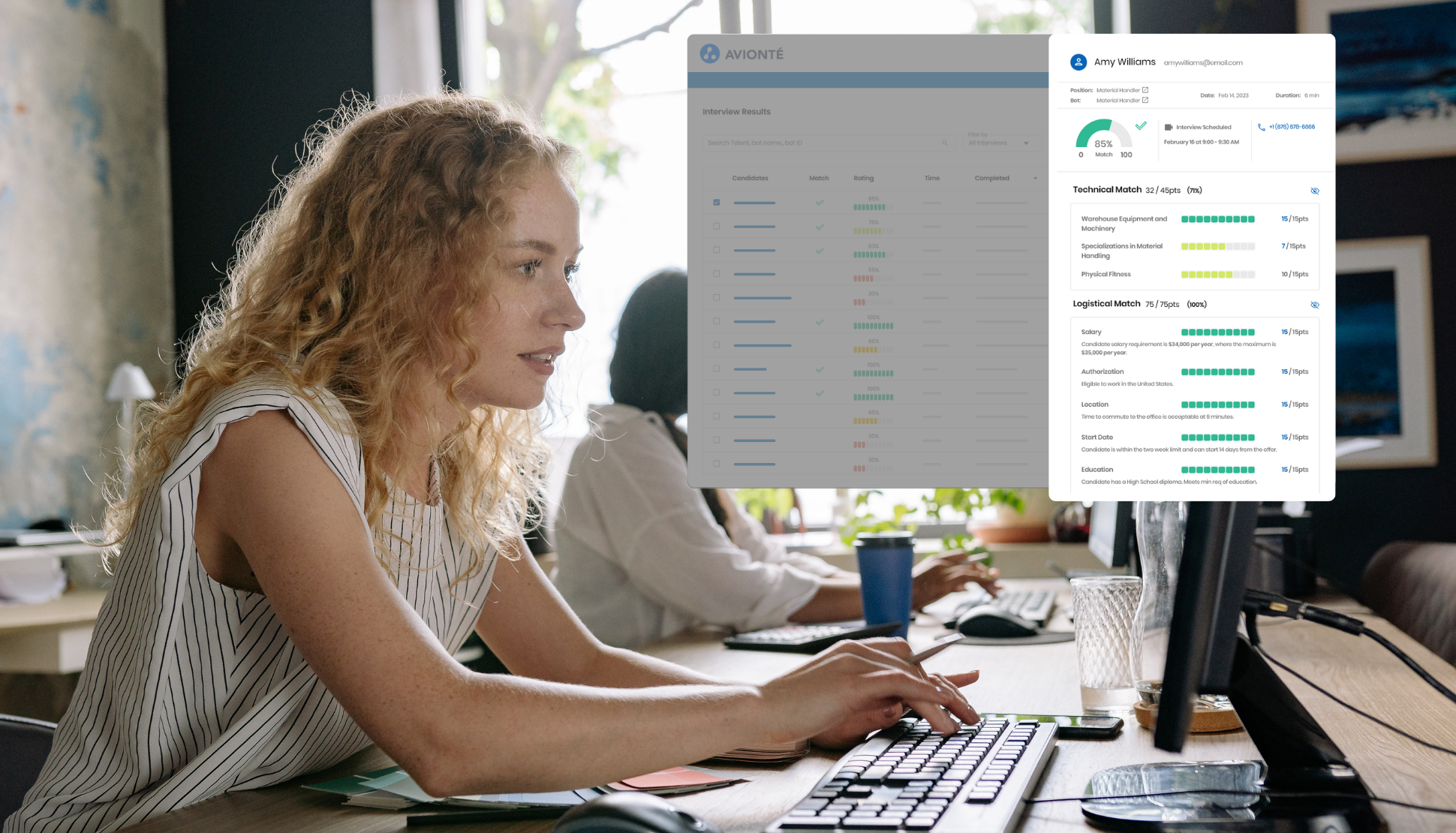
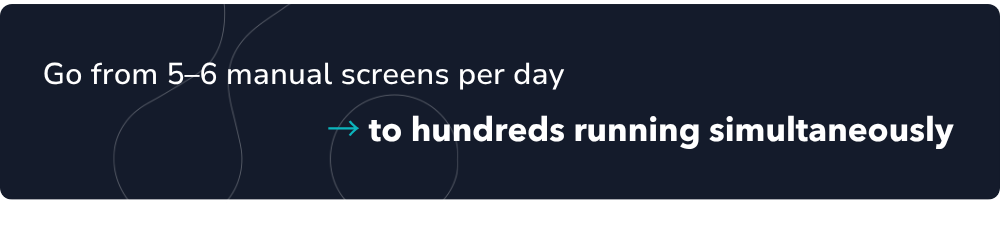
AI-powered voice and interview bots change that entirely. Integrated directly into AviontéBOLD through certified Avionté+ third-party integrations with solutions like Sense, Alex, Whippy, Glyde, ConverzAI, CuratelyAI, StarsHunt, Tenzo, PurpleFish, and HeyMilo, these tools allow agencies to interview hundreds of candidates at the same time. Instead of a recruiter managing five or six screens a day, your organization can conduct hundreds of structured interviews nonstop.
Every candidate receives a consistent, professional experience. Transcripts, skill tags, and structured responses flow directly back into BOLD, while sentiment analysis helps the AI understand and respond like a human would, engaging candidates naturally and picking up on cues that indicate fit or potential concerns. And with multiple certified solutions available, your Avionté account manager can help you find the tool that best fits your market, volume, and specific goals.
This isn’t about replacing recruiters. It removes the volume bottleneck so your team can spend their time where it matters most: building relationships, evaluating top candidates, and delivering talent to clients faster than the competition.
-
Challenge #2: You Have the Call Data, But Not the Insights
Every call your team makes contains valuable insight. Sales conversations, recruiter screenings, client check-ins — each one holds signals about what’s working and where deals are falling apart. The problem is that most organizations only look at the data for results: placements made, deals closed, or revenue generated. Very few dig into the fundamentals: how are your recruiters and salespeople actually performing in their day-to-day interactions? Patterns, behaviors, and missed opportunities often go unnoticed.
That’s where Ringover, a certified Avionté+ partner, changes the equation. Integrated directly with BOLD, Ringover doesn’t just record and transcribe calls. It analyzes them using large language models to surface coaching insights almost instantly.
After a single call, a recruiter or sales rep can see exactly where momentum shifted, where objections surfaced, and how the conversation could have been handled differently. Metrics such as pacing, talk-time balance, and tone are clearly visualized, so reps can understand what happened and adjust immediately.
At the leadership level, the impact compounds. Sales managers can identify patterns across dozens or hundreds of calls without having to listen to every recording. New reps receive meaningful feedback after their first day on the phone, and experienced reps continue refining their approach based on real data.
It’s the kind of continuous improvement most teams want but rarely achieve because the insights were always buried in the data — they just weren’t accessible fast enough.
-
Challenge #3: Timekeeping Is Still Running on Screenshots, Photos, and even Napkins
For agencies working with field or light industrial talent, timekeeping can still feel stuck in another decade. Handwritten timecards, photos from job sites, screenshots texted to coordinators, and then someone on your team manually enters it all into the system.
It’s slow, error-prone, and it pulls skilled staff away from more valuable work.
REEA Global, an Avionté+ Certified Integration, utilizes AI-powered optical character recognition (OCR) to streamline the entire process. An employee simply emails a timecard, whether it’s on a form, a scrap of paper, a spreadsheet, a PDF, or any other medium.
The system captures the email, extracts the image, reads the information, organizes the information, and automatically inputs the data into BOLD’s timekeeping system. From there, it functions exactly as if the worker had entered their time digitally themselves.
The result is more accurate and precise time data, faster payroll processing, and no manual re-entry. Errors decrease. Overpayments become much less frequent. End-of-period payroll pressures vanish. And because the information is delivered to BOLD as structured data, billing, reporting, and compliance workflows all operate more smoothly.
Key Takeaways
- Take a Problem-First Approach to AI Adoption – Don’t chase every new tool. Identify your biggest operational challenge, define what success looks like, and implement one solution at a time. A methodical approach creates more momentum than doing everything at once.
- Leverage AI to Scale Candidate Screening Without Burning Out Recruiters – AI-powered interview bots integrated with AviontéBOLD can conduct hundreds of structured screens simultaneously, feeding transcripts and skill tags directly into your ATS so recruiters focus on relationship-building and top-candidate evaluation.
- Turn Every Call Into a Coaching Opportunity – Conversation intelligence tools like Ringover analyze pacing, tone, and talk-time balance to surface actionable insights after every recruiter and sales call, helping teams improve continuously without managers having to review every recording.
- Automate Manual Timekeeping With AI-Powered OCR – Tools like REEA Global eliminate handwritten timecard entry by reading and extracting data from any format — paper, PDF, or spreadsheet — and pushing accurate, structured data directly into BOLD’s timekeeping system.
- Trust a Vetted Integration Ecosystem – Every Avionté+ certified partner is validated to work reliably within the full platform stack, so agencies can confidently add AI-driven solutions without worrying about compatibility, data gaps, or broken workflows.
The Real Impact: AI and Integrations Driving Smarter Staffing Operations
None of these examples is theoretical. They tackle everyday challenges staffing organizations face regularly: screening candidates quickly, boosting team performance, and cutting manual administrative tasks.
And they succeed for a straightforward reason. Each solution is built on a platform designed to enable intelligent automation from the beginning, with structured data, purpose-built APIs, and a trusted integration ecosystem.
Through Avionté+, every partner undergoes vetting before integration to guarantee their technology works exactly as promised within the larger platform environment. Agencies don’t have to risk using tools that may or may not be compatible with their systems. The solutions are tested to operate reliably across the entire technology stack.
The result is a partner ecosystem that agencies can trust, whether the solution is AI-driven or not.
You don’t need dozens of AI tools. You need the right solutions to solve the right problems, connected through a platform capable of supporting them at scale.
That’s exactly what Avionté was built to deliver.
Next Steps
We’d be happy to walk you through the platform and give a straightforward look at how AviontéBOLD is built, where we’re headed, and whether it aligns with your goals. Let’s talk.