Recruiting teams are under constant pressure to move faster without sacrificing quality. Writing job descriptions, screening applicants, scheduling interviews, and evaluating candidates all take time. And by the time you identify the right candidate, they may already be off the market.
An AI recruiting workflow for staffing agencies removes bottlenecks at every stage of the hiring process. By combining AI job description generation, chatbot pre-screening, candidate scoring, and AI interview support, agencies can reduce time to fill while improving candidate experience and recruiter productivity.
Here’s what that looks like when the process is built around the day-to-day realities recruiters face, with workflows optimized by Avionté’s AI tools and focused on outcomes that directly impact speed, quality, and fill rates.
AI Job Description Generator for Recruiters
Every placement begins with a job description. When recruiters draft postings manually for every new requisition, it slows momentum before sourcing even begins. In high-volume environments, those delays ripple across the entire pipeline.
Recruiters are often balancing multiple openings at once. They’re working quickly to capture job requirements, translate them into compelling postings, and get roles live as soon as possible. When that process takes too long, everything downstream gets delayed.
That’s why speed at the very beginning matters so much.
With Avionté’s AI Job Description Generator, recruiters can create consistent, well-structured job descriptions in a few seconds. Instead of starting from a blank page, recruiters can quickly generate descriptions aligned to required skills, responsibilities, and qualifications, then refine them for tone and accuracy. This not only reduces writing time but ensures jobs are published faster across job boards and distribution channels.
The real impact isn’t just saving time, it’s getting roles in front of candidates sooner, starting the pipeline earlier, and creating momentum from day one.
When jobs go live faster, recruiters get a head start on the entire placement process.
AI Recruiting Chatbot for Pre-Screening Candidates
Once a job is posted, applications can start coming in quickly. But responding just as quickly isn’t always realistic, especially when recruiters are managing multiple roles at once.
This gap between application and response can make a big difference. Candidates lose interest, accept other offers, or disengage if they don’t hear back soon enough. One of the most critical breakdowns in recruiting happens between application and first response. Candidates expect immediate communication, especially in competitive markets where multiple agencies may be contacting them at once. If recruiters cannot respond quickly, interest fades and opportunities are lost.
That’s where immediate engagement changes the experience.
With Avionté PIXEL, Avionté’s pre-screening AI chatbot, candidates can be contacted as soon as they apply. The chatbot can ask pre-screening questions set by the recruiter about experience, location, pay expectations, and availability, qualifying candidates instantly and even scheduling interviews when criteria are met. Recruiters have full insight into how Avionté PIXEL responds to candidates, in the event they want to explore why PIXEL responded a certain way.
For recruiters, this means conversations start sooner. For candidates, it means they feel acknowledged right away.
By closing the response gap, agencies reduce ghosting, increase engagement rates, and move strong candidates forward while interest is still high. The result is a more responsive and candidate-friendly hiring experience.
AI Candidate Scoring Software for Staffing Agencies
As applications accumulate, another bottleneck emerges: identifying who to prioritize. High-volume roles can generate hundreds or thousands of applicants, making manual resume review inefficient and inconsistent.
This is where Candidate Scoring helps bring focus.
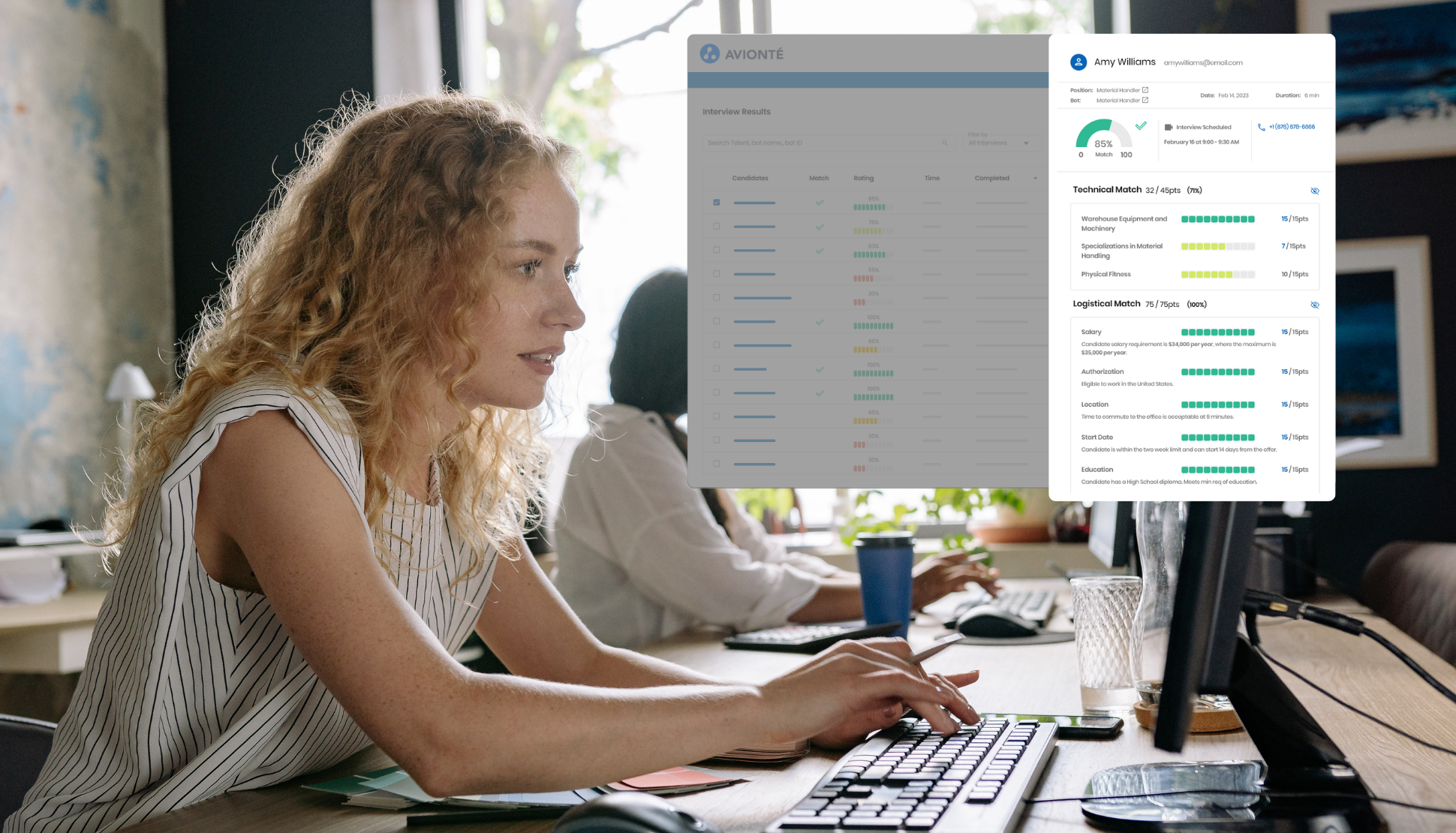
For candidates who complete the Avionté PIXEL pre-screening interview, Avionté’s Candidate Scoring ranks applicants based on how closely their qualifications align with job requirements. Instead of reviewing resumes sequentially, recruiters can begin with a shortlist of high-match candidates. This prioritization ensures time is spent where it matters most, engaging strong prospects rather than filtering out poor fits.
For high-volume staffing, where recruiters need to review hundreds (potentially thousands) of applications, this is a huge time saver. Instead of arriving at work on Monday morning to an inbox full of applications, recruiters can review a short list of candidates who are a strong fit for the role. And if the candidates have completed the pre-screening interview with Avionté PIXEL, recruiters may have a calendar full of interviews.
This shift changes how recruiters spend their time. Less energy goes into reviewing poor-fit applicants, and more time goes into building relationships with candidates who are likely to move forward.
For staffing agencies competing on speed, this shift is transformative. Recruiters can submit candidates faster, improve placement quality, and reduce the risk of missing top talent buried in a large applicant pool.
AI Interview Question Generator for Structured Hiring
Interview preparation often happens between meetings, emails, and deadlines. Even experienced recruiters can find themselves pulling together questions at the last minute. When preparation is rushed, interviews can feel inconsistent, making it difficult to compare candidates fairly or evaluate key competencies thoroughly.
Support from Avionté’s Generative AI Interview Questions provides recruiters with structured, role-specific questions aligned to job requirements. More importantly, it helps bring structure and consistency to each conversation. By bringing consistency and clarity to interviews, recruiters can explore skills more deeply and assess candidates more objectively. This structure improves the quality of evaluation and supports better hiring decisions.
Stronger interviews ultimately lead to stronger placements. When recruiters walk into conversations prepared and focused, they gain clearer insight into candidate fit and can move forward with greater confidence.
How an AI Recruiting Workflow Improves Staffing Performance
None of these moments exists in isolation. Each one builds on the last.
- When jobs go live faster, candidate pipelines grow sooner.
- When candidates are engaged immediately, momentum builds.
- When top applicants are easier to identify, decisions happen faster.
- When interviews are stronger, placements happen with more confidence.
It all adds up to a smoother, more connected recruiting experience.
Recruiters spend less time on repetitive tasks and more time where they add the most value. Candidates move through the process faster and feel supported along the way. Clients see quicker results and better matches.
And the business outcomes follow:
- Faster time to submit
- Faster time to fill
- Higher fill rates
- Increased recruiter productivity
- Stronger candidate experiences
Why AI Recruiting Software Is Essential for Modern Staffing Agencies
In today’s staffing landscape, speed and responsiveness define competitive advantage. Agencies relying on manual workflows risk losing qualified candidates to faster-moving competitors. AI recruiting software enables agencies to automate repetitive administrative tasks, improve communication speed, prioritize top candidates intelligently, and scale operations without adding headcount.
Importantly, AI enhances recruiters rather than replacing them. By removing early-stage bottlenecks, recruiters gain more time for relationship-building, client strategy, and closing placements.
Next Steps
Want to see how a modern staffing platform can help your staffing business be more efficient? Schedule a free consultation call today.