Key Takeaways
- Develop a staffing analytics roadmap: go from basic reports to real‑time intelligence to gain a competitive edge.
- Integrate data across ATS/CRM, payroll, billing and performance systems to unlock full business insights for staffing agencies.
- Move beyond historic metrics and use predictive analytics to anticipate talent demand, margin pressure and placement trends.
- Tailor your analytics maturity strategy to staffing workflows—ensure your dashboards reflect recruiter, client and branch‑level performance.
- Choosing staffing‑specific analytics tools ensures agility, scalability, and data‑driven decision‑making for light industrial, healthcare, clerical, and professional staffing operations.
The days of running a staffing firm purely on intuition and spreadsheets are over.
In a labor market where margins are tight and competition fierce, staffing agencies that win use data—not guesswork—to make strategic decisions. This means evolving from basic reporting to integrated analytics and full business intelligence tailored for staffing.
In this post, we walk through the analytics maturity model and show how your agency can grab control of its data, create connected insights, and use real‑time dashboards to outpace rivals.
So, where does your staffing business stand? And more importantly, where do you need to go next?
From Staffing Report Cards to Real‑Time Analytics: The Evolution of Staffing Metrics
Your recruiters are filling jobs. Your sales team is on the phones. On the surface, everything looks fine. But if your profit margins keep slipping and you don’t know why, that’s a warning sign: you’re working hard, but not necessarily smart.
The problem? Most staffing firms get stuck in a reporting loop by focusing on past performance instead of analyzing patterns, forecasting trends, and optimizing operations in real-time. Without integrated data pulled from your ATS and CRM software, you’re making decisions with incomplete information, and in a market this competitive, that’s a dangerous gamble.
The Analytics Maturity Model: The Three Levels of Data Mastery
Analytics isn’t just about tracking numbers—it’s about transforming raw data into actionable business intelligence. Every staffing firm falls somewhere on this maturity curve:
Level 1: Operational Reporting (The Basics You Can’t Ignore)
- Real-time reports on recruiter activity, talent placements, and payroll
- Visibility into basic performance metrics (e.g., fill rates, starts, and fall-offs)
- Tactical insights for daily operations
This level is essential—but it’s also the bare minimum. You know what’s happening in your business, but not why it’s happening or how to improve it. You’re flying with a dashboard, but no GPS.
Level 2: Integrated Data Analytics (Where Strategy Begins)
- Data from multiple sources (ATS, CRM, VMS, talent engagement, payroll, etc.) unified into a single view
- Visibility into recruiter performance, client profitability, and operational efficiency
- Metrics that connect activity to financial impact
At this stage, you’re no longer just collecting data—you’re leveraging it. Instead of reacting to problems, you’re identifying what drives profitability and making strategic decisions based on evidence.
This is where staffing firms start pulling ahead. They stop making across-the-board investments and start allocating resources where they generate the highest ROI.
Level 3: Advanced Analytics & Custom Integration (The Competitive Advantage)
- Full access to raw data for advanced analysis
- Custom metrics and predictive modeling
- Seamless integration with business intelligence tools (Power BI, Tableau, Looker, etc.)
At this level, staffing firms aren’t just optimizing their business—they’re predicting the future. Instead of scrambling to respond to market shifts, they anticipate demand, pinpoint new opportunities, and adjust their strategy ahead of the competition.
This is the difference between playing the game and controlling the board.
Is Your Agency Falling Behind? The Red Flags to Watch For
Wondering whether it’s time to level up? If any of these sound familiar, the answer is yes:
- Spending hours manually pulling reports instead of accessing real-time insights
- Struggling to measure which clients or industries drive the most profit
- Making decisions based on gut feel rather than clear financial data
- Recruiters and sales teams working from different sets of numbers
- Competitors making faster, more confident decisions while you’re still gathering information
If you’re seeing these red flags, you don’t just have a data problem—you have a business problem.
Unified Data Architecture in Staffing: Integrating ATS, CRM, Payroll & Billing
Investing in analytics isn’t just about choosing a BI software—it’s about building a foundation for smarter decision-making. Here’s what that looks like:
-
Data Architecture: Get the Foundation Right
If you don’t structure your data correctly, even the best analytics tools won’t help.
-
Integration: Eliminate Data Silos
Your analytics platform should seamlessly integrate with your existing ATS, CRM and VMS tech stack to unify your data. If you’re still manually stitching together spreadsheets, you’re already behind.
-
Scalability: Plan for Growth Now
Staffing firms don’t grow linearly—your data needs will explode as you scale. Enterprise-grade analytics solutions must be able to handle increasing data complexity without slowing down performance.
-
Technical Expertise: Build or Partner?
Let’s be real: advanced analytics requires skilled expertise. If you don’t have an internal team with the right data experience, you have two options—train your people or work with external specialists who can help implement and manage your analytics strategy. Doing nothing isn’t an option.
The 90-Day Action Plan: How to Level Up Fast
You don’t need years to transform your analytics capabilities. You just need a focused strategy. Here’s how to make it happen in 90 days:
Phase 1: Audit & Prioritize (Weeks 1-4)
- Identify where your data gaps are—what insights are you missing?
- Define the 3-5 key metrics that would most impact your decision-making
- Assess your current reporting tools and capabilities
Phase 2: Build & Implement (Weeks 5-8)
- Invest in the right analytics infrastructure and tools
- Ensure seamless data flow between front office, back office, and finance
- Train key stakeholders to start using data for decision-making
Phase 3: Optimize & Scale (Weeks 9-12)
- Move from static reporting to unified analytics
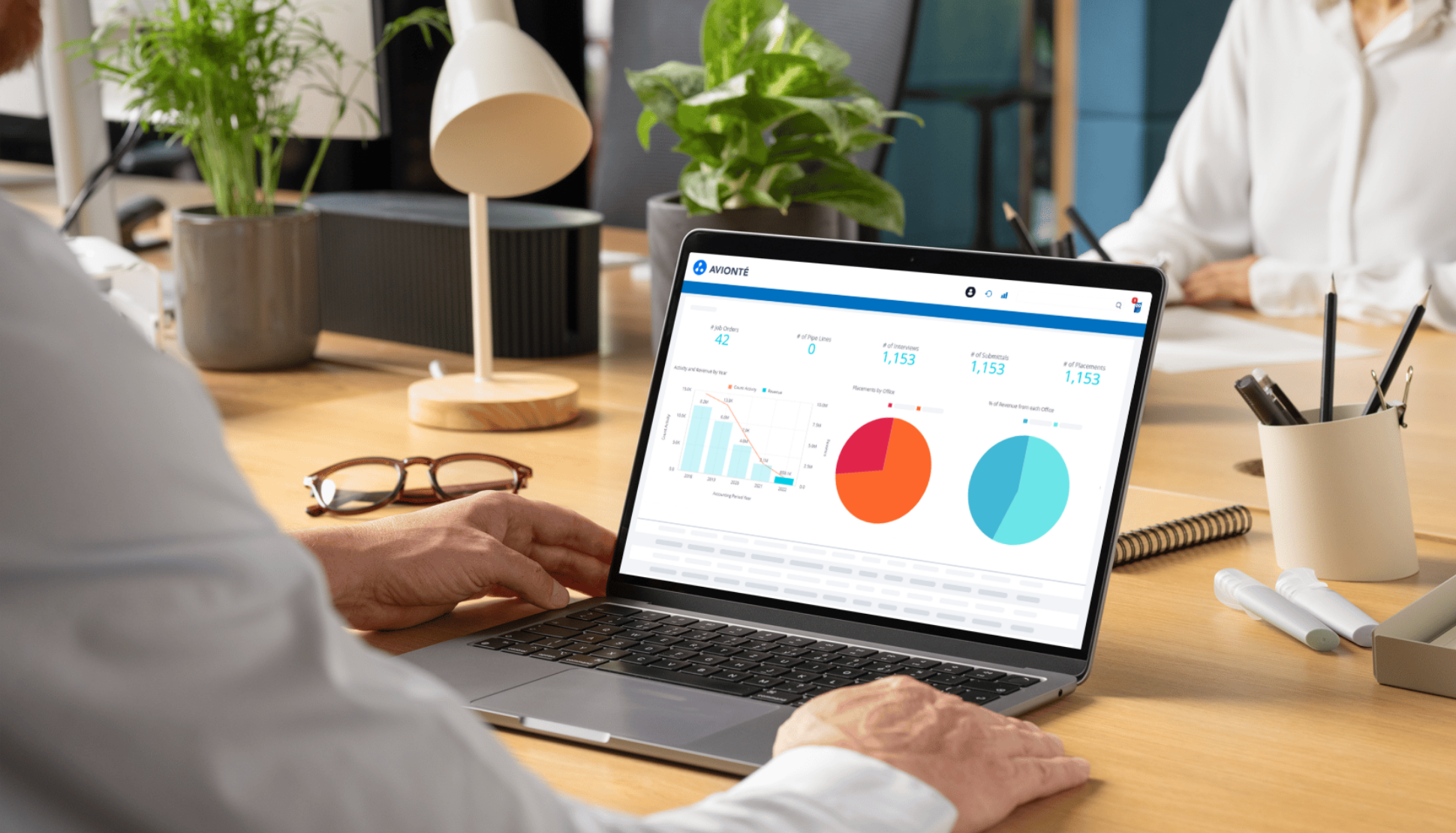
- Implement automated dashboards for timely business insights
- Continuously refine metrics based on business impact
The Future Belongs to Data-Driven Staffing Firms
The staffing industry is at a crossroads. Some firms will continue to operate on outdated reporting, making decisions with incomplete information. Others will embrace analytics maturity, using data to drive every strategic move.
The difference between the two? Success or stagnation.
The firms that thrive in 2025 won’t necessarily be the biggest. It will be the ones that know how to turn data into a competitive advantage.
So the real question is: Which side of that divide will your agency be on?
If you’re ready to take control of your data and future-proof your staffing business, Avionté Staffing Software offers an analytics ecosystem designed to help staffing firms at every stage of their analytics journey. Let’s build a smarter, more profitable future—together.
Next Steps
Want to see how a modern staffing platform can help your staffing business be more efficient? Schedule a free consultation call today.
Frequently Asked Questions
What is the difference between staffing reports and business intelligence?
Basic staffing reports show historical performance data, while business intelligence tools analyze trends, connect data sources (like ATS, CRM, payroll), and deliver predictive insights for faster, smarter decisions.
How can staffing analytics improve recruiter productivity?
By tracking key performance indicators like time-to-fill, gross profit per recruiter, and redeployment rates, staffing analytics help managers coach effectively and optimize workflows.
What types of data should be integrated in staffing analytics?
Top-performing staffing agencies integrate data across ATS/CRM, payroll, billing, client performance, and candidate engagement to get a full operational picture.
Can small staffing agencies benefit from business intelligence?
Yes. BI tools help smaller agencies make smarter decisions without hiring analysts—especially when using pre-built dashboards tailored to staffing KPIs.
What are the most important KPIs for staffing analytics?
Key KPIs include gross profit by recruiter, time-to-fill, job order aging, placement success rates, and client margin contribution—especially when viewed by branch or vertical.
Is it hard to implement business intelligence in a staffing agency?
With staffing-specific BI solutions like Avionté, implementation is straightforward. You can start with core dashboards and scale over time without disrupting daily operations.