Artificial intelligence is making candidate sourcing faster, cheaper, and more accessible than ever. If every agency can source talent at the same speed and cost, the question becomes: Why would talent choose to work with you? The future of recruiting may have less to do with finding candidates and more to do with keeping them. But how?
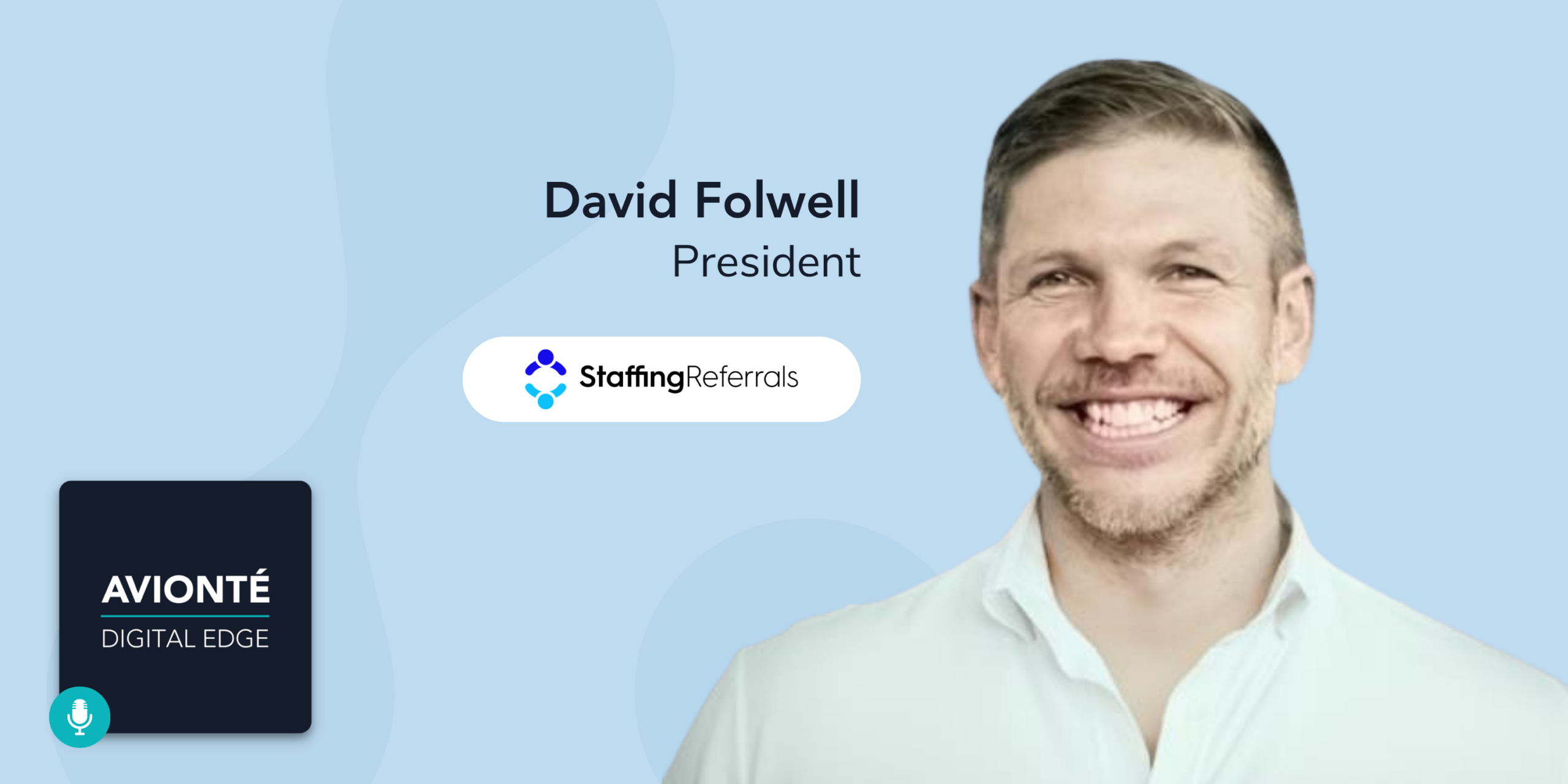
In the final episode of this four-part series, host Chris Ryan sits down with David Folwell, President of Staffing Referrals and Founder of Staffing Hub. Throughout the series, David has shared a fresh perspective on the metrics and strategies shaping the future of staffing. In part 1, we explored why Candidate Lifetime Value could transform staffing strategy. In part 2, we discussed how to measure talent loyalty. In part 3, we examined how to turn that data into a powerful sales advantage.
In this final episode, we explore how AI is redefining recruiter value and how staffing firms can use it to drive measurable business results. Together, they discuss why talent loyalty is becoming a lasting competitive advantage, how agencies are responding with new talent incentives and role-based specialization to stand out in a crowded market, how AI empowers recruiters to spend more time building meaningful candidate relationships, and how strategic use of AI can improve profitability, increase redeployment, and create long-term growth.
This is a partial transcript of the full conversation. Listen to the podcast episode for the complete discussion.
Chris Ryan:
So, David, let’s start with the Staffing Hub findings, which came out recently.
The report that was published shows a real profitability gap between the agencies that deploy AI strategically and those that don’t. But when you dig into where those gaps show up, it’s not in sourcing. Walk us through what the data actually says about where AI-driven agencies are winning.
David Folwell:
Honestly, this is the conversation I’ve wanted to have all series because it’s the one that makes people nervous.
You framed it years ago at Staffing World. Productivity in this business shifted from the cost of acquiring a new person to the candidate’s lifetime value and the lifetime margin that person actually delivers to your agency. And that’s the whole thing in one idea. AI just made the acquiring part something everybody can do at the same speed and the same price.
So, the game moved to what happens after that. Do they stay? Do they come back? Do they bring three friends with them? And you had a line back then that I’ll steal: AI may not take your job, but somebody who uses AI will.”
And I’ve actually heard that so many times in the last two years that I’ve told people that we should have a drinking game around it.
But it was true then and even more true now. AI has given leverage to those who use it in a way that allows them to scale their capabilities and profitability.
Chris Ryan:
Yeah. You know, David, it seems to me that sometimes we put AI on a pedestal, but really it’s simply another form of highly powerful automation. And, like any automation, when you bring it up and you put it to work, it changes things. And the people who adopt automation are the ones who tend to succeed. And I think your Staffing Hub report kind of showed that with AI.
So, tell us a little bit more about the actual Staffing Hub findings.
David Folwell:
Yeah, I mean, I think one of the things that was interesting is we couldn’t pin it down to saying, “All right, if you put AI on sourcing, you are better.” It was AI across multiple processes – up to five processes – that we saw incremental growth in.
And I think that goes to show that if you’re looking at how to replace things that you do today with smarter, more efficient processes, you are going to see results from AI. I think that for companies dabbling in it and saying, “Well, we tried it with one process,” it might take two or three before you even learn how to do it profitably.
So, I think that’s one of the findings. And another interesting piece from the State of Staffing is that operational excellence was highly tied and correlated with growth as well. This means that you’re tracking the KPIs, you have weekly meetings, and the standard business operations you expect from high-functioning teams are really important and highly correlated with success. And it also ties back to the idea that if you’re doing those things well, you’re probably going to operationalize AI well.
Chris Ryan:
It’s interesting. So, really, it’s about the holistic application of AI across your entire operation and how you deliver value to your customers.
So, rather than looking for one little application that’s going to move the lever, they’re asking how can AI systemically help my entire business operate better.
David Folwell:
Absolutely, and a lot of people ask, “Well, what AI tool should I use?” which is completely the wrong question. It’s about which jobs we have at our company where there’s friction that can be replaced by AI, and what is the outcome of doing that well?
How impactful would it be if, instead of having a recruiter call 100 new job applicants a day, we applied AI to it so the process ran in 10 minutes instead of 8 hours of someone’s time?
And when you think about it from a holistic perspective about the outcome and the ROI that you could have, and measure that as well, which goes back to that operational excellence, it’s much more impactful than saying, “Well, we’re trying this thing because it’s the new AI tool to try.”
Chris Ryan:
And as you talk about outcomes, what strikes me is: where and how can AI actually create value for an employer that they would want to work for your firm? Also, where and how can AI create value for the talent you want to attract and retain?
How do we actually use AI to create value? And it’s not about just finding a panacea that’s going to make our business a little better. It’s about continuing to focus on what matters most, which is delivering the talent employers want and keeping the talent employers want.
So, with that in mind, that leads us to our next question, and it’s a question I think a lot of agency owners haven’t really sat with, which is: why would talent choose you and your staffing agency?
And the reason I ask it that way is that if AI is commoditizing sourcing, and every agency can find and reach the same candidates, they can go to the same job boards at roughly the same speed, then the differentiator flips to the talent side of the equation.
So, a warehouse worker with a forklift certification, a travel nurse, an electrician, these are people with options. So, why would they choose your agency over the one down the street or over going directly to an employer? And what makes an agency the employer of choice for talent?
David Folwell:
Well, talent chooses you because you offer something of real value. You’re focused on career development. You offer real choices. When we’ve surveyed talent in the past, this was years ago, we were doing travel nurses, and a lot of travel nurses selected agencies just based on the number of options that they had.
The key thing here is that you are offering real, meaningful value to the talent in a differentiated way. I think your brand in the market comes from the experience that you create for the candidates. And the agencies that I see growing fast right now are doing a few things. They create value for the talent, as I mentioned, in a very clear and differentiated value proposition.
We have customers who are focused on delivering additional benefits, or they’re offering things that you just can’t get from other agencies. Sometimes it’s the relationships, sometimes it’s more options. I like to think of it as: how can you segment the population you are talking to and align those value props to the population you want to serve?
They’re also very reliable, and they offer consistent work. They know that if they come back to this agency, they’re going to have something for them again, and they’re not going to have to think about it. I think one thing that’s very undervalued in our industry is how easy it is to work with you.
And I think the career coaching and development resume workshops – a lot of those elements are really, really impactful for building loyalty and showing people that you care about them and, again, keeping them in your talent community.
And then lastly, I think a mobile experience is really important. There are expectations that candidates have. For years, we’ve been talking about the consumerization of staffing, and I think it’s fair to say it’s here and then some and accelerating even further.
Chris Ryan:
So, boy, there’s a lot to unpack in that answer. I want to explore this a little bit more. One thing that is clear, when you talk about delivering value to talent, it’s pretty hard to do if you’re working with a lot of different kinds of talent.
I mean, what a traveling nurse needs and what an electrician needs in terms of support are very different. So, is one aspect of this that, in the future, staffing agencies are likely going to become increasingly vertically specialized in order to cultivate the talent who they need to attract?
David Folwell:
Absolutely, and I would even go further than that.
I think that a lot of agencies will say, “I’m specialized because I do travel nursing.” And I am seeing agencies that say, “We’re a travel nursing staffing agency, and within that, we have a group of travel nurse recruiters that focus on ER. We have a group of travel nurse recruiters that focus on, I don’t know, the ICU.”
But basically, how do you go a step further in that specialization and have it down to the individual skills, beyond just the concept of travel nursing? I think that that hyper-specialization down to specific role-based specialization where you know the language, you know how they talk about their jobs as well as they talk about them, and you can talk about challenges in that way, that’s where I think you can create even more value. And some of the companies that are growing through these harder times are focused on training people at that level.
Chris Ryan:
It’s funny. It reminds me a lot of a development in the retail space years ago. There was a time when there were stores like Sears, where you could go in, and you could buy a TV, you could get a Craftsman saw, and then you could go up to the children’s clothing section, and buy clothing for your kids.
And it was essentially a general-purpose store. But then, retail evolved to category killers. So, what was once Sears’ hardware store is now a Lowe’s or a Home Depot, where it’s a complete category killer. You go to Best Buy, and it’s a complete category killer for all things electronics.
And it sounds to me like what you’re saying is that staffing is going to move that way too. That you can’t just be into travel nurses, you have to be into every facet of that experience. You have to live it, eat it, breathe it, be able to speak to it, and be able to market to it.
Is that fair?
David Folwell:
Yeah, and align your recruiting groups to the specialties. If it’s light industrial, maybe you have somebody who’s working on a specific role that they’re like, “Oh, we only do data centers,” for example. That IMA data center specialist, and that is the type of work I’m doing.
So, I think it’s that hyper-specialization. And then I would go one layer up from a marketing segmentation and behavioral segmentation perspective. And I think that a lot of agencies are trying to find the one thing or the one approach.
I think it’s really important to understand: are you trying to be the lowest-cost provider? Are you trying to be the highest touch provider? What is the experience you want to deliver? And have you defined that well and align your experience to that? And I think there are companies out there, and this is fine, who are saying, “We’re going to offer as many jobs as possible, we’re going to do as low touch as possible, and that’s what you get.”
And there is a segment of candidates that are going to enjoy that experience, but then there are also going to be ones who want hand-holding, and I think it’s important to align yourself to the segment of the population you are trying to serve.
Chris Ryan:
That makes a lot of sense.
Now, that actually suggests something else, and you had talked about that, or hinted at that earlier when you talked about brand. Historically, staffing agencies are not really big in marketing their brand in many cases, except for enterprise staffing agencies.
But, going forward, if you want to be known as the company that has all the skilled trades necessary to build a data center, then you probably would want to have a strong and memorable marketing brand, and constantly be blasting out to the employers in that marketplace, as well as the talent in that marketplace, so that they would come and find you and want to work with you.
Is that where we’re going?
David Folwell:
I’m kind of doubling down on this, but I think the level of specialization is critical. I think focusing on the areas you want to serve, maybe looking at where the fastest-growing segments of the industry are, and aligning your team to specialize in that, making sure they have the expertise to deliver on it.
So, for example, if you’re looking at data centers, I’ll use that example again, I would have a section on your website that talks about it. Have a section on your website where you have testimonials and quotes from the people that you work with at data centers to show that you know data center staffing.
And while it might seem like most of the job is the same, there are always nuances, there are always little things that actually matter, and there are ways that you talk about it that matter. And I think that the areas of focus and having that be part of your brand is going to be something that we’re going to see more and more agencies move towards.
Dan Mori, I bring him up all the time, because I learned so much from him. But he always talks about the importance of specialization, and I think it’s just where the industry’s been heading. And I think it’s going to go there even faster with AI commoditizing the entire top level of sourcing.
And the thing I think is so crazy is that I hired somebody a couple of months ago, and put a job on Indeed, and I had 200 resumes in an hour. I have AI sourcing and matching. I can go find resumes and have matching done for me. So now it’s like, why am I talking to an agency?
And that comes down to what additional value do you create? What expertise do you bring, and what can you bring to the table?
Chris Ryan:
Yeah. That makes sense. Just as an aside, why do you think some staffing agencies are so reluctant to be all in, or to commit to a specialized approach and a strong brand identity?
David Folwell:
Having run a marketing agency for 15 or 20 different companies, the experience that I’ve had with so many CEOs is that, well, if we say we do that, then our other customers might think that we’re not for them. And so, from what I’ve seen, it’s the fear of excluding a customer segment by having those on there.
And the reality is that the customers who work with you because they like working with you are still going to work with you, but the focus is going to help your team – and you – move into a more profitable and faster growth path. And so, I think it’s a critical step and can be challenging. It’s important that you spend time thinking about the focus.
But, from my experience, it’s been the: “We don’t want to push any of our current customers away or think we’re not for them.
Chris Ryan:
I think that really talks to the insecurity of making a commitment to a specific market or segment because you might be losing opportunities elsewhere, and that makes so much sense.
So, we’ve talked about the importance of specialization; we’ve talked about the importance of marketing and brand identity. We’ve talked about the importance of being able to engage and retain talent over a long period of time. We’ve talked about the fact that recruiting, at least at the top of the funnel, some of that is going to be commoditized by artificial intelligence, but also, frankly, by the existence of job boards that were already in place and were beginning to commoditize recruiting.
So now, as we imagine the staffing agency of the future, let’s talk about what this means for core recruiting functions and operations. A couple of years ago at Staffing World, I laid out a thesis. It was more of a thought experiment at the time.
But I laid out a thesis that the general recruiter role was going to split into a number of specialized functions, and I had come up with five. One of them was the talent coach: the person who is able to take talent and constantly reskill and retrain them so that they can continuously be redeployed.
And that would be something that would be very attractive to talent. It also ensures that you, as a firm, are staying on top of the things that are most important. Another was the talent marketer. And, as I was thinking about this, if I have a specific skill or trade, I don’t want to just work for anybody.
I want somebody who understands my role and my job as well as I do, and who speaks my language. So having somebody who can speak to talent, an electrician who can speak to other electricians, a nurse who can speak to other nurses, a tool and die maker who can talk to other people who work in the auto industry, that’s going to be really important to me.
So, that was the second one. A third was the digital recruiter because with all this artificial intelligence, you still have to direct the AI technology to what you want it to accomplish and what you want it to do, and somebody has to translate the knowledge of the job into what it is that AI needs to do in order to deliver value to the company and to the talent.
And then you might need somebody, an operations manager or somebody who makes sure that you’re actually delivering to the customer, and ensures that people are being paid in the appropriate way. And finally, you’re going to need people who are workforce planning consultants. It’s kind of a dual sales and recruiting role, somebody who understands things.
So, the idea is, and you had asked me about this earlier, David, does one recruiter have to be all of these things? And my thought was that there is no single person who can do all of it well, but you could come up with a team-based delivery approach that might be able to pull all of those skills together into a pod.
So, I know that’s a long preamble, and, so David, I’m going to ask you, based on what you’re seeing in the data and across the agencies you work with, is that happening? Or what is happening? Are you seeing an evolution in the way we are organizing and deploying recruiters? And what do you think the team structure’s going to look like in the agencies that are actually pulling ahead?
David Folwell:
I kind of mentioned it earlier in terms of the shift I’m seeing, which is that we’re going to break our recruiter pods into very tight verticals around specific job titles. I think the way you’re thinking about it, with the different roles, these are all critical. I think that the idea of the digital recruiter, the talent coach, the talent marketer, I think all of those are key.
The interesting part that I’ll be excited to see is do those all line up into a cohesive pod, or is the talent coach something that we layer AI on top of a staffing agency, and the AI becomes the career coaching component, and you have a recruiter who has different capabilities that they use AI with to kind of support these roles?
But I do think that the underlying, operational side of an agency, these are the roles you need to have to build loyalty and retention. How it plays out for the individuals and the recruiting team, I’m not exactly sure yet. I think AI is changing my mindset on that very rapidly.
Chris Ryan:
Say more about that. What are you thinking?
David Folwell:
The coaching component of it: AI-based interview coaching, resume assistance.
Ringover is doing sales and recruiting coaching right now at an unbelievable level, and I personally use AI for weekly coaching recaps of all of my Zoom calls.
What did I do well? What did I not do well? Where should I improve? So, I think the coaching side of it, the digital recruiter, I’ve been thinking more about the idea of the recruiter in the loop. We talk about the human in the loop, and the recruiter is a human.
But I think that a recruiter, potentially, with a handful of agents that could do these things for them in different ways to facilitate a higher scale, could be a path towards a significantly more productive recruiter in terms of placements per recruiter, which is something that we look at quite a bit,
Yeah. It’s interesting because you think of the old-fashioned boiler room where you have twenty recruiters in a room, fifty, a hundred recruiters in a room, and every one of them has an individual quota.
They have to do so many calls. They have to do so many searches. They have to be working on so many assignments and have to demonstrate a certain amount of production. And, my sense is that, in the future, we’re going to have a lot fewer recruiters, but those recruiters are going to be highly trained and likely working in teams, and working with group incentives rather than having everybody for themselves; you get to eat what you kill.
What are your thoughts on that, David?
David Folwell:
I think the future is where recruiters are going to be like Iron Man.
Instead of handling 25 travelers on assignment, or 50 placements a month, or 100 placements a month, they’re going to be doing double that, triple that, and they’re going to be doing it because they have AI surrounding and supporting them in roles that, simply, you couldn’t have done from a financial perspective previously.
And so I think the future of this is going to be interesting and exciting, and when we rolled out automation, and we all talked about automation, it was like we’re going to automate the non-human parts away, the parts that are mundane, and we started doing that, and it did some of it.
But static automation doesn’t have the capabilities AI does to be conversational, and I think this is going to truly get rid of a lot of the parts of the job that people just don’t like doing. And it’s going to be able to do it at a scale we’ve never seen. And so, yeah, it’s exciting.
Chris Ryan:
So, one final thing I want to talk about regarding the future of the recruiter, but it goes a little bit beyond what we’re seeing right now. At least, a trend I’m seeing in the employer community is that they don’t necessarily want traditional W-2 staffing anymore. I mean, sure, they still want it for some roles, but in many cases, they’re asking for statement-of-work-based project delivery.
Sometimes they want a captive contingent workforce and an employer of record for a compliance-heavy solution. Or maybe they want RPO support for high-volume, internal hiring. And I guess, my thought here is: if your agency only has one delivery model, you might be leaving money on the table and making it easier for a competitor to take the client.
Is it possible for recruiters to support more than one mode of delivery? I mean, historically, you always had W2 staffing, employer of record, statement of work. They’re often handled as separate divisions. Is it possible to use the same pool of recruiters with different delivery modes depending on the customer’s needs?
David Folwell:
I believe so, if you roll it out correctly. I think recruiting excellence is recruiting excellence, and if you have trusted networks and relationships that you can bring good people in, I don’t necessarily think it’s going to matter if you’re in a statement-of-work role or if you’re in a traditional high-volume role.
I think you’ll be able to apply these across different modalities. That’s what I believe today anyway.
Chris Ryan:
So, last question, and we’ve covered a lot of ground across four episodes, and if you had to distill it to one message for a recruiter listening to this right now, or someone mid-career who is good at their job, or for that matter, the agency owner who’s hired them, what would you tell them?
David Folwell:
Start growing your skill set around AI and start building your network today. Focus on relationships that drive long-term commitment and referrals for talent that isn’t on job boards.
Your future as a recruiter comes down to doing three things well: investing in yourself, learning the industry, reading up on relationship building, getting excellent at your craft and how you communicate about it, fostering relationships that are going to drive that community and redeployment, and then lastly, building your trust through consistency, reliability, and integrity.
I don’t think the role is shrinking right now. I think it’s becoming more strategic, more specialized, and harder to replace. And the harder to replace means it’s also harder to become a recruiter. So, I think the bar is actually going up, and the recruiters who want to be told what to do are going to be automated out.
I think the ones that build those three things become the portfolio managers of a talent pool and will be the winners in the long run.
Chris Ryan:
You know what’s funny, David, is I think what you’ve described would have made an excellent recruiter 30 or 40 years ago.
It’s back to the fundamentals. It’s back to how we create value in the role. So, I think it’s great that we start with artificial intelligence, but we end up back at the beginning, what recruiting excellence really is. So, David, great conversation. Thank you.
Guest
David Folwell
President at Staffing Referrals
David Folwell is a staffing industry innovator who has spent his career helping recruiting agencies grow through the power of referral networks and partner ecosystems. As the founder of Staffing Hub, David has built a community for staffing professionals. He brings a relentless drive to connect staffing firms with the tools and relationships they need to scale.
Host
Christopher Ryan
Chief Strategy & Marketing Officer at Avionté
Christopher Ryan leads the Strategy and Marketing functions for Avionté. He brings more than three decades of consulting, thought leadership, and corporate experience in Human Capital Management.
About Avionté Digital Edge
Modern technology has revolutionized the way we live, work, and play. It’s also what’s fueling the gig economy which has dramatically changed employment practices. So, what does that mean for staffing and contingent work? In our Avionté Digital Edge podcast series, we will speak directly with industry experts to explore topics and trends related to the digital transformation of staffing and temporary employment in the US workforce.
Subscribe to Avionté Digital Edge on These Platforms