Everyone talks about employee retention and talent loyalty, but few staffing agencies have a clear, repeatable strategy for making it real. In an industry where fill rates, show rates, and redeployment define success, loyalty isn’t a slogan. It’s a competitive advantage that directly impacts client satisfaction and revenue growth.
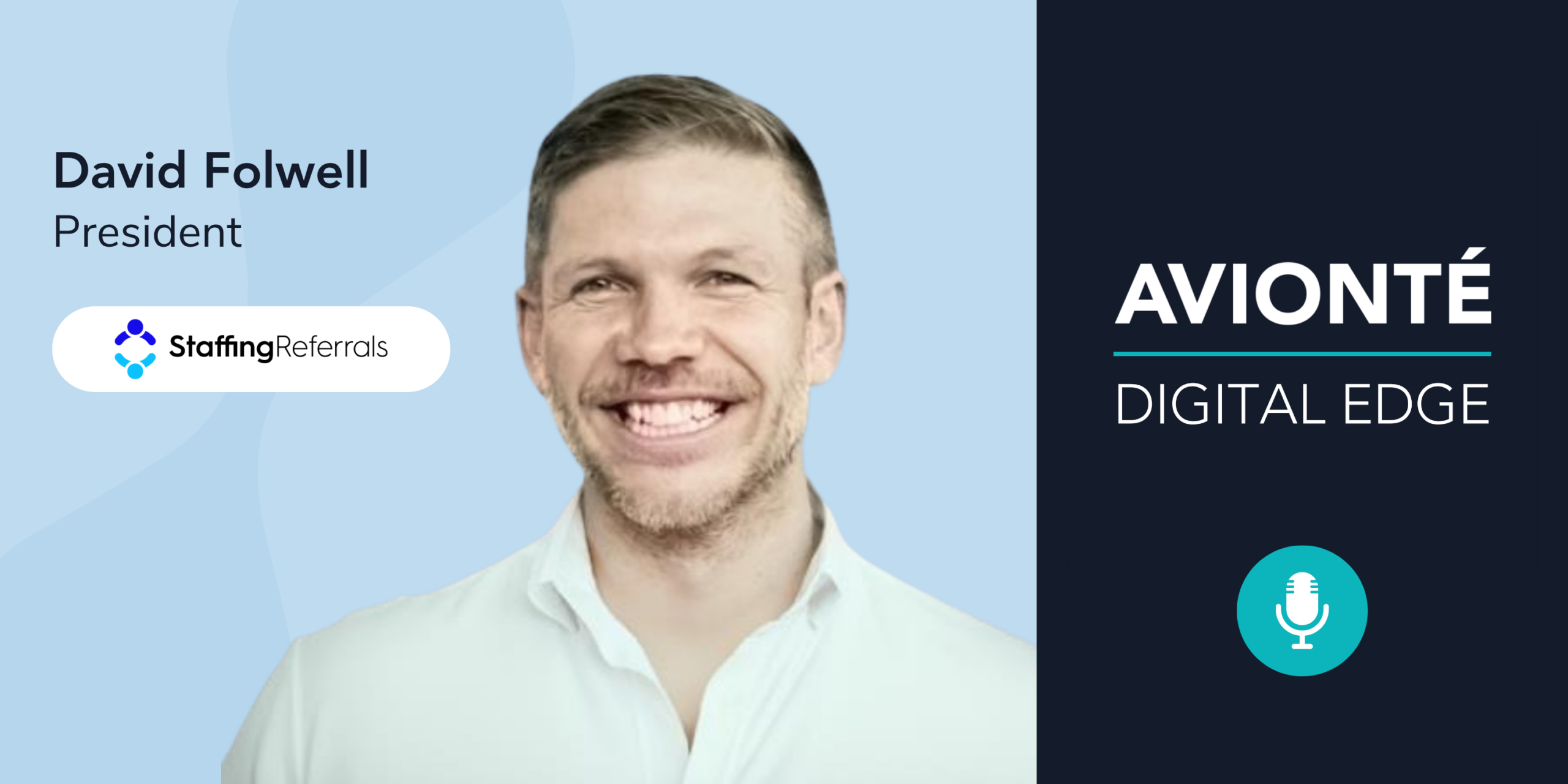
In part two of our Avionté: Digital Edge series, host Christopher Ryan is joined by David Folwell, Founder of Staffing Hub and President of Staffing Referrals. Together, they break down how leading staffing agencies are building talent loyalty in practice, how they are measuring it to drive sales success, and how to turn it into a sustainable, repeatable operating discipline. The conversation also explores how emerging AI technologies are reshaping the way agencies engage, retain, and grow their talent pools to drive long-term value.
Did you miss part one of this discussion? Listen here.
This is a partial transcript of the full conversation. Listen to the podcast episode for the complete discussion.
Chris Ryan:
I want to start from the client side of the table. If I’m an employer and I use staffing agencies, I hear talent loyalty, and I think, “Why should I care? These people don’t work for me. They’re your employees.”
So, make the case, why does talent loyalty at the agency level matter to the employer who’s actually using that talent every day?
David Folwell:
I want to relate it to the staffing agency first, and then talk about it from the employer perspective, just real quick.
So, I know last time we talked about candidate lifetime value, which is one of the more important metrics for gross profit for long-term profitability. And I think, if you’re an agency, you’re listening to this, the stat that I like to bring up, and I think it’s always interesting as well, is this whole concept of what is the value of a customer over the lifetime of working with you.
Chris, do you know how much Starbucks makes on average per customer?
Chris Ryan:
I have to believe it’s a very large number for those customers that come back every other day. So, let’s work this out. If I spend $5 on my mocha latte, and I do it, say, three days a week, 50 weeks a year, I think we’re talking about a couple thousand dollars.
Is that about right?
David Folwell:
So, the average gross profit earned on one customer at Starbucks is over $14,000. That is based on 2,820 visits over 20 years. And I think that same idea applies to staffing. And staffing firms historically have been thinking about redeploy rates, which is the same concept, which is really, really important for the profitability of your firm.
But when you take that now to the client side, it’s like why does a client care about loyalty? It comes down to turnover costs. If you’re working with a client and you say you have a loyalty program where you’re focused on loyalty of your talent, they are going to think, “All right. You guys are doing something different to make sure I don’t have to hire more people from you.”
And ClearlyRated cited an estimate of $1,500 per hourly worker on turnover. But the range is anywhere from 10% to 33%. That is the cost of replacing somebody, and if you can avoid the retraining, the knowledge transfer gaps, all of that, you are delivering more value to your clients.
And you’re also showing them that you care about the quality of your workers and that you care about who you’re putting on assignment because they’re a good fit for them.
Chris Ryan:
So, if you can actually prove to an employer that you have more reliable talent, and you back it up with data, does that change the competitive dynamic when you’re trying to win business against three or four other agencies?
David Folwell:
Absolutely. And we have customers who do that today, and there’s a lot of ways to do this.
But if you’re going to talk to a client and the client has access to Indeed and all the job boards, and so do all of your competitors, how are you differentiating what you’re delivering if you’re just using job boards?
The reality is, if you can say that my talent works on average forty percent longer than the average tenure of my competitors, or of these other sources, then you are delivering more value to them because they’re not going to have to go hire somebody again.
They’re going to reduce the effort and time it takes to keep people on contract, and that shows that there’s a lot of things that go behind loyalty. But it is something that is being used today to drive more client sales.
We have customers who are using their talent network specifically in their presentations to customers, where they’re actually showing, “Here’s the number of people in our talent base, here’s the duration of time they work, and here’s how much higher quality that is compared to what other agencies are delivering.”
Chris Ryan:
Yeah. So, I’m imagining now that I’m a staffing agency, and I’m walking into the employer, and I say, “I’ve got more loyal, better talent than anyone else.”
And the employer says, “You know what? The guy who came in before you said the same thing.” What is the most persuasive data that you can actually bring to the party to show an employer that you are the agency of choice?
David Folwell:
I was just at the Staffing Sales Summit, Dan Mori’s conference, which is amazing, and somebody on stage said: “Everybody says we have the highest quality candidates.”
And the idea that you’re going to walk in and say that and have it be believable… It’s easy to say, but if you actually want to prove you have a higher-quality candidate, there are a few things you can do that are pretty straightforward and hard to refute, and one of those is to track the time on contract.
Compare that to other benchmarks in the industry. What is your time on contract? What is your redeploy rate? How many times do you get referrals from the people who work with you? These are all elements that verify the quality of the candidate and are symptoms of you focusing on putting the right people in the right place.
Chris Ryan:
So, the bottom line is you can’t boast unless you have the numbers to back it up. But if you got the numbers to back it up, nobody’s going to argue with you.
David Folwell:
Yeah. I think you have to have the data.
What is the size of your network? How many referrals are you driving on an annual basis? And we have customers that get 50% of their placements from referrals. If you can go into a customer and say, “50% of our business is coming from a referral,” not only are you showcasing that you are delivering quality, but you’re also saying, “I have access to talent that’s not on the job boards.
I have access to talent that isn’t just readily available to every single person that’s out there looking for them.” And so, you’re delivering a unique value in a few different ways.
Chris Ryan:
So, let’s make this concrete because talent loyalty sounds great. Redeployment sounds great. Everybody wants it. But what is it that a staffing agency needs to do in order to create a loyal talent base, versus other agencies that are just passing candidates through the system? Is this a once-and-done? Is it somebody at the top making a decision that we’re going to retain more talent?
What does it actually look like to create talent loyalty at the ground level in an agency?
David Folwell:
Well, I think one of the funny things is everybody always wants the silver bullet for anything, and there just simply isn’t, and this is one of those categories where there are a lot of elements that go into driving loyalty.
I’ll start by talking about how can you see if you have loyal talent, and obviously time on contract, redeploy rates. Also, are they referring people to you? Are they becoming brand ambassadors? Are they responsive to your organization? But those are the things that are symptoms of having the loyal talent.
But at its core, loyal talent happens from psychological factors. Do they trust you as an agency? Are you easy to work with? Are you reliable? And then I think if you’re doing those things well, you could start thinking about adding a rewards and recognition program on top of it.
One mistake that I frequently see agencies make is that they’re like, “Okay, we’re ready. We want to build the best referral program, or we want to build the best loyalty program,” and they don’t have the core element of psychological safety and trust built in. And so, I think you need to stop looking at talent from a transactional lens and really be relational with talent first.
And once you’ve done that, you have a high net promoter score, you have some referrals working, then you start layering in rewards and recognition, and you can give visibility to points and things along those lines as well.
Chris Ryan:
So you’re almost saying that it’s great to have a referral program, but you don’t just put it in as an appendage to the back of your agency.
You have to have a holistic approach. Talent loyalty is something that you intentionally have to build on a day-to-day basis with every interaction you have with talent, whether you’re talking about pay, commitments, opportunities that you’ve delivered, training that you’ve provided, or the relationships.
Whatever it is that makes people feel safe, warm, loved, trusted, and paid – presumably that’s what drives talent loyalty. Is that fair?
David Folwell:
Completely fair. And one of the things that we now start with is, “Do you have a good net promoter score? Do you have a good reputation?”
And if you don’t, if your net promoter score is really terrible, and you have a bunch of terrible Google reviews, don’t focus on a referral program or a loyalty program. You need to focus on creating good experiences first. People are not going to stay on contract longer with somebody if they don’t have the core elements built in, and people don’t refer to agencies that they don’t like.
If they don’t like working with you, the referral program is not the right place to start. So, I think one of the things that we talk about a lot at Staffing Referrals is: There’s the component of the platform, and the program and the rewards and the bonuses, but the referral culture being part of this as well – where we treat people well, we have a good culture, we have all of these elements – can be a core driver of making sure that the software on top actually drives the value you need.
Chris Ryan:
Yeah. So, it almost sounds like you’re doing leadership consulting at the front end. I mean, if I’m a staffing agency leader, and I sit down and I say, “Hey, I want loyal talent.” The first thing you might ask them is: Why does talent want to work for you versus anyone else?
David Folwell:
We’ve actually had a customer who bought from us, canceled, and then came back a year later and said, “We want to figure out what we did wrong.” And that’s where we built the referral culture consulting component, because we were like, ” Okay, well, if we’re going to do it again, you need to actually follow up with referrals quickly. You can’t let the referrals sit in the inbox for two days.”
If somebody takes the time to refer somebody, there’s a whole bunch of things that go into it, and they are excelling now because they’ve shifted their internal dialogue around referrals, and that matters a lot for the success of these programs.
And it has to start at the top.
Chris Ryan:
Got it. So, obviously, when you’re running a staffing agency, you might think, “Well, referrals, they’re not that important. I could do that tomorrow.” But basically, you’re saying it has to be part of the day-to-day urgency in the way you run your staffing agency.
David Folwell:
I think everybody wants to buy software or plug-and-play silver bullets, and to have it fix everything. And what we say is, if you’re not getting any referrals today, don’t buy our software. Don’t buy referral software from anybody. Go figure out if people are willing to refer to you first.
Once you have people willing to refer you, and you think you’re doing okay, and you’re like, “All right, there’s some referral momentum,” that’s when it makes sense to automate and scale these things. So, I think that sometimes people think automation is the solve.
Automation is the scaling mechanism. It’s the fire on top of what works well, not the starting point, a lot of times.
Chris Ryan:
Yeah, that’s an interesting notion. So, leadership drives culture, policy drives culture, and then software drives the scale. Pretty nice formula there.
So, let’s talk about redeployment data, since that’s certainly one of the metrics that can be very important to both an employer and a staffing agency. Tell us a little bit about some of the data that you are seeing through your work, and how much more likely is a referred candidate to take on a second assignment, and what does that do to the economics of running an agency desk?
David Folwell:
So, last time I think I’d shared some data from the previous year, and we’ll be releasing this data soon, but we went back and looked at 450,000 candidates across 880,000 placements from ’24 to ’25. And we looked at the average days worked, and this is counting redeploys as well.
And for healthcare, referred candidates averaged 180 days versus 99 days from a job board.
Chris Ryan:
So, that’s nearly double.
David Folwell:
Yeah, It’s insane. And I will say this, referred versus a major job board, one thing I would let everybody that’s listening to this know, over and over again, the top two highest retention channels are going to be your referrals and those people that come direct to your website as well. So, people who know who you are and are coming back to you because they like you. Those are the top two.
But for healthcare: 180 to 99 days. In light industrial, it was 64 days versus 36 days. And for travel nursing specifically, I pulled the redeploy rates, and the average redeploy rate for a travel nurse was 2.4 assignments from a referral, compared to 1.45 for a non-referred candidate.
And that is an insane difference in terms of what you actually make on the talent, and also what your customer thinks about what you’re delivering to them.
Chris Ryan:
So that almost says that one referral candidate is worth two job board candidates.
And beyond that, you’re going to have a much happier employer, presumably because you’re going to have less turnover on the job, which is absolutely huge.
David Folwell:
Less turnover, and your recruiters have to do less work.
I mean, we’ve talked about this case study as well, but the WSI is one of my favorites. We looked at their data, and in 2024, their placement volume went down eight percent, and their revenue was up nine percent.
So, they just did less work and gained more revenue and gross profit. And that’s one of the things that we see flowing through, and we’re even having customers start talking about: “Should we incentivize our recruiters differently based off of the source of talent? Should the recruiter’s commission be different when they go to a more profitable channel?”
If they get them from their network or from a referral, that is technically more profitable for you as an organization, so why are you paying the same across whatever channel they use?
Chris Ryan:
Yeah. It makes sense to reward the recruiter for the lifetime value of the talent they bring in because it’s literally the gross margin under management that they’ve delivered. And, that measures the real result. Not, “Hey, I found 10 bodies, but four of them aren’t…
David Folwell:
Yeah. They’re all going to be our lowest quality candidates…
Chris Ryan:
So, yeah, it makes a lot of sense. So, in past discussions, you’ve said that staffing agencies that build talent loyalty, and do it really well, make it a core top-down focus, and it’s part of their day-to-day strategy and operation.
Talk to me a little about what that looks like in practice. For example, you’ve mentioned things like- loyalty program mechanics similar to an airline miles concept. Maybe you’ve seen something interesting with incentives for other things. What are some of the best examples you’ve come across?
David Folwell:
Yeah, there are a few companies that are doing this really well. There’s one that’s built their business around it, has branded it, and has it out in the marketplace. And they have a handful of different things that they use to reward talent in different ways.
They’ve actually created a loyalty score for every candidate based on an algorithm that they’ve built into the ATS.
But some of the simpler ways to think about this is how you can get a certain number of points for every referral you submit. Assignment completion can be rewarded. Attendance is something that some customers are rewarding.
I don’t know anybody doing this yet, but it’s something that there’s a lot of conversation around, which is learning and development. Are you getting the certification? Let’s give points around that.
And so, starting to think about: What are the things that drive value for your organization that you need that also help the talent. And then building a system around that where you reward points that align the talent perfectly with what your goals are, and also with your clients’ goals.
And it’s no different than incentive alignment at your organization. You’re just taking it from, “Okay, we’re doing internal incentive alignment where we’re extending that to our talent so that we are going all the way through to the customer to maximize the value you’re delivering.”
Chris Ryan:
That makes great sense.
So, if an agency buys into this… they believe talent is a recurring asset, and they really put some effort behind that, and loyalty, it’s a real strategy, not just a talking point, what should they actually be measuring? What are the two or three metrics that you would start with to benchmark your program and to track it over time to make sure that it wasn’t just a feel-good program?
David Folwell:
So, I’ll start with the three metrics. I would start with redeployment rate, referral rate, what percentage of people actually refer to you, and then candidate lifetime value.
And you could start with just the total number days worked or hours worked. But I think a lot of people track the redeployment rate, and then they say, “How do we get our redeployment rate up?” And they’re like, “Well, let’s send more emails.” And that’s going to drive redeployment rates up.”
And it does. Sending more messages will drive more redeployment rates. But also creating really amazing experiences are going to drive redeployment rates up. So, thinking about how do we actually treat this person in a way that’s going to make it so that I don’t want to switch anywhere else.
I want to stay here because of the experience and the level of care I’m receiving can be really impactful as well.
Chris Ryan:
And, presumably, you wouldn’t send your best talent to your worst employer clients either.
So, let’s talk about the elephant in the room: artificial intelligence. Every time I read anything now in SIA or ASA, all anyone wants to talk about is artificial intelligence. And a lot of artificial intelligence has been pointed towards efficiency gains, but it strikes me that AI could really make a difference in how we deliver value to customers.
So, what I’m wondering about is how AI could be used for talent loyalty programs, either in the measurement, execution, tracking, and validation of loyalty schemes? Give me some examples of where you think AI might have some potential with talent loyalty to drive higher lifetime value of talent.
David Folwell:
To your point, AI is revolutionizing everything in a very impactful way. How do we source faster; how do we screen faster; how do we write messages faster? And everybody’s chasing that, and everybody should be implementing on that front. Thinking about how AI can help us stop losing candidates, how AI can help us retain candidates is really impactful.
And there’s ways to think about the experience. How quick are you to respond to concerns that they have? How quickly can they get things answered that can be impactful, that are pretty low-hanging fruit, that can drive better experiences?
We were just talking about using unstructured data. A couple of people that we’ve worked with and have shared customers with are Ringover and Toro. And we’re in conversations thinking about: At what point can you use the unstructured conversational data to identify sentiment, where if it’s a positive sentiment, that’s an opportunity for a referral and drive somebody in, but it also could be an opportunity to figure out different ways and opportunities to reward points.
I think that the big play here is going to be two things. One: figuring out ways to use data that a human would not have been able to go through previously to identify what loyal talent looks like, and to identify the archetype of who we should hire, and who’s going to stay on contract longer.
And then I think the second part, which we’re digging into, is more of the concept of the talent graph, and looking at who they are connected to, who in the network do they know, how can we give you signals that would identify that they’re a higher quality candidate who can refer people to you as well. And those are two of the plays that are going to have a bigger impact, but not in the immediate term.
In the short term, what’s live on our platform today is AI outreach that basically handles all of the touchpoints related to referrals, ensuring consistent, reliable, conversational outreach through AI SMS. So, it’s basically like your referral recruiter who’s asking you if you know anybody, can update you on where you’re at in the referral program, and that ties into loyalty over time as well.
Chris Ryan:
To me, the real power of large language models is working with unstructured data. I certainly don’t need a large language model to do a Boolean search. I’ve seen wonderful applications of AI where you can take large amounts of unstructured data, identify real insights, and create a plan to drive higher talent loyalty.
It does make a lot of sense. How you could deploy AI and actually maximize value, because I’m not sure employers always want speed first. Don’t get me wrong, speed is always important in this business.
But first with excellent talent is even better. And that to me is where the industry is going. It’s got to be around the quality of the talent delivered on an ongoing basis. That’s really what’s going to make or break companies over the next five to seven years.
David Folwell:
It is. I think it’s going to be everything.
I think we’re moving towards a world where the job boards are going to offer free AI sourcing and screening capabilities. Access to resumes. It’s going to be easy to find talent. The hard part is going to be: Are they verified? Are they trusted? Are they in network? Is their reputation good, and how do you know that they’re actually high-quality?
And that’s where the proprietary networks come in. I think that’s what the future of modern staffing agencies are going to look like.
I think it’s why a lot of the forward-looking agencies are talking with us about how to start moving towards where things are going, and I think that’s going to be really impactful. Also, on the AI front, it used to be that you needed to have the really structured, prompt engineering. And this guy, Nate Jones, who’s unbelievably forward-thinking in where AI is going, and I’ve already seen this firsthand.
But it used to be: How can you ask AI the exact right question you need to ask, and how do you prompt engineer this in the perfect way? And the thing that is changing, and the way I like to think about it, is that AI is becoming the smartest person ever in the entire world. And if you’re sitting next to the smartest person you’ve ever met, would you think about telling them exactly how to do their job?
Or would you say, “How would you solve this problem?” And I think we’re moving towards a world with AI where you could do what you just said, which is say, “I’m trying to figure out how to drive loyalty. Here’s the data in my database. How would you create a program to drive more loyalty?” Or, “What data would you look at to figure this out?”
And I think we’re moving into a world where AI is becoming much more capable of solving these problems with much less guidance.
Chris Ryan:
Yeah. And David, I have to say, I can’t agree with you strongly enough about this.
I see so much time and energy being spent with AI just focused on: “Let’s have an artificial business development rep,” or “let’s try to improve efficiency in some way… when the delivery of value, ultimately, is where AI is really going to have a huge contribution to the industry.”
Guest
David Folwell
President at Staffing Referrals
David Folwell is a staffing industry innovator who has spent his career helping recruiting agencies grow through the power of referral networks and partner ecosystems. As the founder of Staffing Hub, David has built a community for staffing professionals. He brings a relentless drive to connect staffing firms with the tools and relationships they need to scale.
Host
Christopher Ryan
Chief Strategy & Marketing Officer at Avionté
Christopher Ryan leads the Strategy and Marketing functions for Avionté. He brings more than three decades of consulting, thought leadership, and corporate experience in Human Capital Management.
About Avionté Digital Edge
Modern technology has revolutionized the way we live, work, and play. It’s also what’s fueling the gig economy which has dramatically changed employment practices. So, what does that mean for staffing and contingent work? In our Avionté Digital Edge podcast series, we will speak directly with industry experts to explore topics and trends related to the digital transformation of staffing and temporary employment in the US workforce.
Subscribe to Avionté Digital Edge on These Platforms