





Jun 1, 2022
How Talent Enablement Technology Can Transform The Candidate Experience
According to data provided from Avionté, an industry-leading provider of software solutions for staffing companies,
Read More

Most businesses focus heavily on customer lifetime value. Companies like Amazon analyze years of purchasing data to predict how profitable a customer will be long before the next transaction occurs. They know who to invest in, who to keep, and where to direct their resources. However, in staffing, where the product is people, and relationships generate revenue, few organizations apply the same level of analysis to the individuals who actually produce their profit: the candidates they place.
In this episode of Avionté: Digital Edge, host Chris Ryan interviews David Folwell, President of Staffing Referrals and Founder of Staffing Hub. David has dedicated years to studying referral-driven sourcing and the long-term value candidates provide to agencies. Together, they discuss the idea of talent lifetime value, why different sourcing channels yield vastly different profit results, and how agencies can start leveraging talent data to make smarter decisions about recruiting, redeployment, and long-term growth.
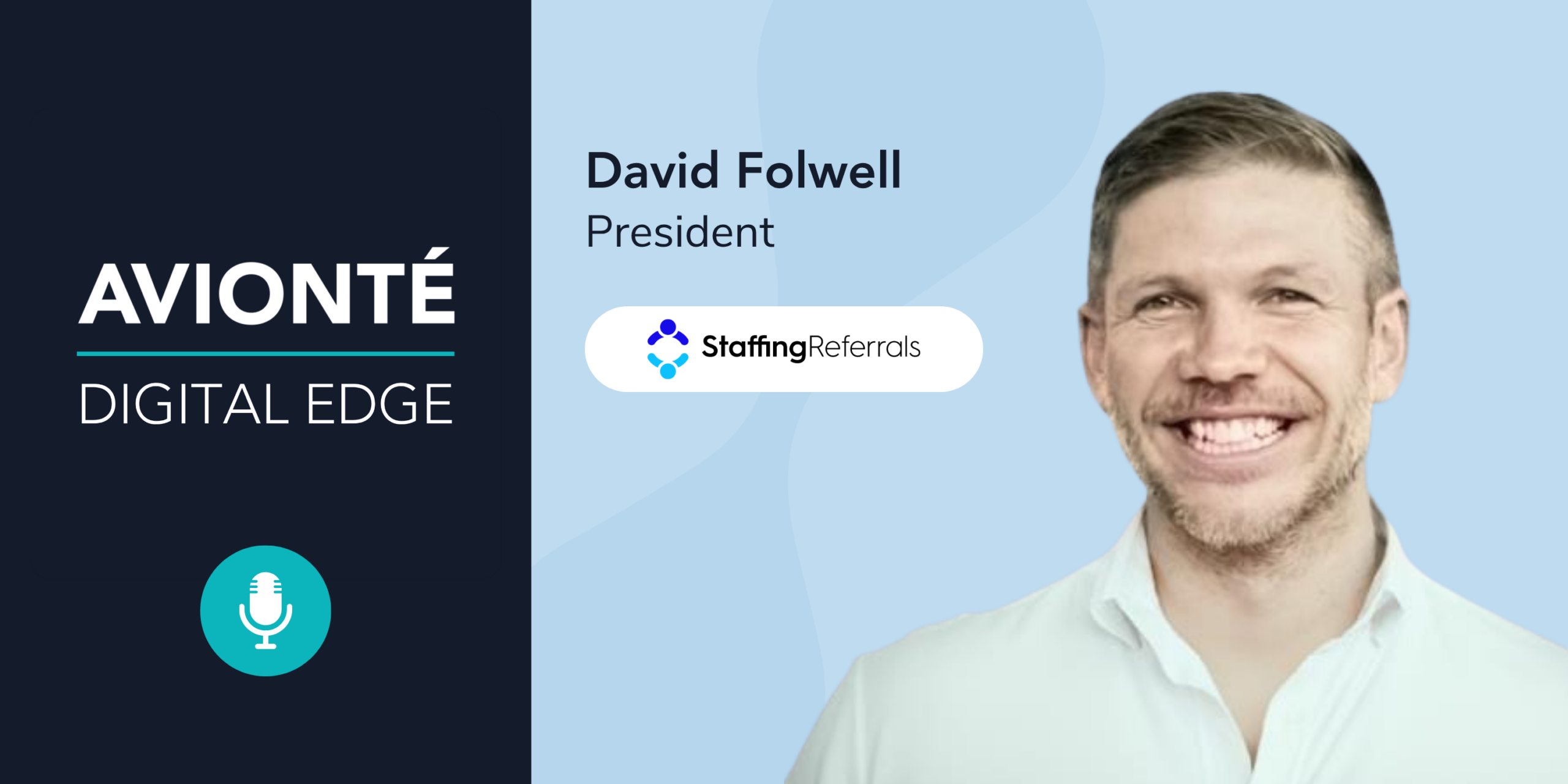
This is a partial transcript of the full conversation. Listen to the podcast episode for the complete discussion.
Chris Ryan:
David, here’s the thing that keeps nagging me. A lot of staffing agencies use lifetime value and LTV-to-CAC ratios to evaluate their sales teams and their client relationships. So, they already know the math. But almost nobody applies the same logic to their talent.
If I asked a hundred agency owners what a candidate is worth over their lifetime, not a placement, but a candidate, how many could give me a real answer? And why is this gap so persistent?
David Folwell:
The “why is it so persistent” question, I’m not exactly sure. But I do know that well over 90% of agencies are getting the sourcing ROI math wrong. They’re not really looking at how to approach it and thinking about it in a way where they could be driving a significantly better ROI on their approach to sourcing by simply using the candidate lifetime value metric across their talent pool.
Chris Ryan:
So, to make sure we’re all on the same page, let’s talk about how you actually define this concept. I mean, when we say candidate lifetime value, or talent lifetime value, what are we actually talking about? How do you define it in straight dollars and cents?
David Folwell:
Yeah. So, candidate lifetime value equals the Bill Rate x Hours x Margin x the Redeployment Rate, minus the Acquisition Cost. And this will give you the gross profit over the lifetime of a candidate. And a lot of agencies think about how much they make on the first placement for a candidate. What they’re forgetting to factor in is the redeployment, and/or the change in time on contract, based off of the source of the talent and where they got that talent from.
I think that a lot of agency owners look at a placement as a placement, and that simply isn’t true.
Chris Ryan:
Yeah. Now, that’s interesting because when I think of the lifetime value of talent, and the way you’ve defined it, there are so many virtuous things that go into that number. I mean, to have a high lifetime value per candidate, the employer has to like the talent that you’re providing. The talent has to like the employer and the placed opportunity. You have to have defined effective pay rate and margin with both the employer and the talent.
It means a whole bunch of different things go into making a really high-quality lifetime value. And redeployment, of course, drives it way up, and talent sourcing costs go way down. So, I would think lifetime value is a hugely valuable metric. I mean, it really measures quality, I think is what you’re saying.
David Folwell:
Quality. Profitability.
And it’s something that when you’re looking at candidate lifetime value and thinking about the value of the talent you put on contract, you need to break it up by source. So, you need to look at: what does it look like from a job board? What does it look like from a referral? What does it look like directly from your ATS if you’re doing direct sourcing, your website… There are a few different channels that consistently outperform job boards when it comes to the profitability of the talent.
There are some pretty easy ways to think about this. When you think about why does candidate lifetime value change by source, with a referral, you’re literally going to work with a friend or at a place that a friend suggested you work.
So, the likelihood of them staying on contract is significantly higher. The likelihood of them redeploying is significantly higher. And there’s some other caveats that kind of drive the overall value of the talent based on the source.
Chris Ryan:
Yeah. But ultimately, it sounds like gross margin generated per talent and gross margin lifetime per candidate really is a gold standard.
So, David, let’s talk a little bit about some of your recent research. As I understand it, you were looking at candidate lifetime value by sourcing channel, and you were doing this across multiple Avionté customers. Without naming names, what did your data actually show when you compared referrals against job boards on gross profit, on time on contract, and redeployment?
And how big are these differences? Are these small differences, or is this a meaningful difference that a staffing agency should be aware of?
David Folwell:
It’s actually pretty astounding. So, we looked at 146,000 placements across a segment of our customers and looked at the time on contract, how many days did they work for the healthcare industry, the construction industry, and the light industrial industry.
We found, for healthcare, that a referral versus a non-referred candidate was working on average 48 additional days. In construction, we had an additional 11 days, and a light industrial nine days. So, if you’re a staffing agency and you are thinking about how do I increase profitability and how do I increase my revenue this year…
Most people are thinking, I need more job orders, and more job orders is always going to help. That is not a bad thing to go out and push for and drive. If you cannot get more job orders, one of the ways to start thinking strategically about how to drive profit is thinking about where are you sourcing the talent from to maximize the revenue and the gross profit or gross margin that you’re driving from every single candidate you put on contract.
And that is one of the reasons that we started looking at this. And, you know, referrals are typically the number one in terms of profitability, but I will also add that direct sourcing from your ATS is typically a higher value than a job board. What we’ve also seen is that candidates that come directly through your website, because they know your brand, they’re coming to you, they are using your job board are also typically quite a bit more profitable and stay on contract longer. So, it starts to show you that your brand matters, where you find the talent matters, and this is one of the levers that agencies can pull to drive revenue up.
Chris Ryan:
So, being able to demonstrate that your candidates are onsite longer is a demonstrable advantage over competitors. But, stepping back, what your data clearly shows is that source of candidate matters and drives quality and profitability in a very clear, direct way.
And what you also mentioned is that referrals clearly do better. I’m just curious, why do you think referrals do better than job boards? I suppose it’s intuitive, but what is it about a referral that’s different?
David Folwell:
I mentioned this a minute earlier. The key thing, and it is somewhat intuitive, but when you are referred to work with a staffing firm, the person referring you either thinks this is a good job for you, and they think you’re a good fit for it, and they’re happy to put you in touch with that agency. Or, in many cases, you’re going to work with your friend. And when you’re going to work with your friend, the odds of you staying on that contract drastically.
Also, work satisfaction increases, and typically, the quality of work also increases along with that. And I think the future of staffing is going to be more about quality and more about what are you doing that you can’t do from a job board. What talent can you bring me that is better than the talent I could find on a job board? So, I think there are a couple of benefits that go beyond even just the time on contract.
Chris Ryan:
So, David, one of the examples that grabbed me was a specific case study you had for a CLI staffing agency from the upper Midwest. And, in that particular case, it was kind of a paradoxical result; they were able to increase their revenues by 9%, even while their placements declined by 8%. And that seemed very counterintuitive to me.
So, I’m curious if you could walk us through what was actually happening with that staffing agency. How they got their results and why it matters?
David Folwell:
Yeah, it’s pretty incredible. And it’s not a math error. That is what candidate lifetime value can do to your revenue and your profits.
What they did was they focused on referral quality over volume. The candidates stayed longer, they got more GP per placement, and their revenue grew with fewer placements. One of the incredible things about focusing on talent that stays on contract longer is you don’t have to make as many placements, and you can still have growth within your organization.
And it’s one of the reasons in a tight market like we’ve seen over the last couple of years, this is a lever that most agencies can pull to start focusing on growth and start driving profitability. And there are quite a few benefits that come along with this. Not just time on contract, but you’re getting the redeploy rates. You are reducing your spend on job boards.
And I know Chris, you and I have talked about this a few times, the future of staffing is tied to what are you doing that’s different than what I can do as a company. And when you go to a customer and say, “Hey, we’re going to give you access to our referral network, and it is a unique network that only we have access to.”
That’s something that’s hard to push away. You say, well, we don’t actually have access to that. And the company we’re talking about here is one of my favorite case studies. It’s WSI. And it was, I think, three years ago that they recognized that this was an opportunity for them when they started looking at their own data.
So, they kind of got ahead of it and said, “Where are we driving revenue? Where are our most profitable placements coming from?” And when they looked at their referrals, they really put a strategic initiative in, and they have more than two and a half times their percent of placements from referrals since we started working with them.
It’s been kind of like a rocket ship, and it’s been really impactful to their business.
Chris Ryan:
Wow. So, their revenues are going up, but their talent acquisition costs are going down simultaneously. And presumably their turnover is lower, or undesired turnover is lower.
That, absolutely huge.
David Folwell:
Yes. Less work, more money.
Chris Ryan:
So, let’s tie this in with some research that Avionté did, and something that I recently published in a blog, which was: How Staffing Agencies Actually Source Talent in 2026.
And one of the numbers that jumped out in our study was that we were looking at gross margin contribution from candidates by source across a large swath of our clients. And what we noticed was that candidates who came through referrals were driving almost 34% of the total gross margin.
And job boards we’re only generating about 25% of gross margin, by talent. And yet, the typical staffing agency does about 70% of their placements with a job board. So, what that is is the power of the approach.
Given our study and what you saw, what does that say to an agency owner? And I think it’s important to point out that we weren’t just looking at referrals. We also looked at company websites. We were also looking at local community development activities, for example, with local commerce, job boards, with local community colleges, and community outreach.
And what we saw is that more than 50% of the gross margin was coming from what we would call gumshoe relational activities. Not from digital sources. So, I’m kind of curious about your take on that, and what that says, along with the data that you’ve seen in your own research.
David Folwell:
I think it directly backs up our research. When I saw your report, I was like, “This is incredible to see it from your guys’ side too.” And it is astounding to me to think about the time, the effort, the money that is spent on job boards despite the actual gross profit being driven from the kind of word-of-mouth and referral side of things.
And it seems that there’s just an incongruence in the approach and a big opportunity, I believe, for most agencies when they start thinking about, well, what levers can we pull in this market to start driving revenue? And where should we allocate our funds, our resources, and our approach?
And it’s just, I think, non-obvious sometimes to think about that. But it has a significant impact. And I think your data is just another kind of point that shows exactly what we’re seeing from our side as well.
Chris Ryan:
And I think it brings up an interesting question about what is the right way to use technology to support a staffing agency.
Whether you’re using job boards or you’re doing referrals or local community outreach, technology can play critical role. But you really have to be very intentional about how you apply it and what you’re trying to accomplish.
So, any agencies that are sitting and listening to this, the first question they might ask is, “How do I start measuring a candidate lifetime value by source at my agency? How can I do it? And what’s the minimum viable version? What does an agency actually need to track, and how much precision do they need?”
David Folwell:
A simple starting point, without overcomplicating it, is just to pull all of your placements by source, and compare the gross profit on a candidate level.
So, you could say, “What is the gross profit for each of these sources?” If you take it a step further, and add the time worked, you start to get a little bit better, more accurate math. And then, if you have that redeploy number, you really start to see the real impact. And the redeploy number is the one thing that, I think, frequently gets missed in the formula.
But the initial data on this: for a lot of customers, when they look at where are we allocating resources and where is our actual gross profit coming from, just on that base level, with kind of the math that you did, it can be really impactful in terms of thinking about, “Are we allocating our resources in alignment with where our revenue is being driven?”
Chris Ryan:
So, you’ve actually sat down with a customer and taken them through their numbers for the first time. What’s the first reaction that an agency has when they’re looking at this data for the first time?
David Folwell:
One of the more fun moments is when people get stuck on paying a referral bonus. Like, “why would I pay a hundred-dollar referral bonus if I can get them for less?” And there’s two things about that.
One – if the candidate’s making you an extra $500 on average, it’s worth a hundred dollars. Math works out there quite well. Secondly, you only pay the bonuses when you are profitable. You set the time, work the hours, you set the constraints around the referral bonuses, and I think agencies sometimes forget that.
It’s a guaranteed profitable placement if you construct the program correctly. So, one of the aha moments that we’ve seen is a branch manager at a light industrial agency who was saying, “I don’t really want to pay referral bonuses. I don’t know if we need to do this.”
And then when we showed the math, it was like, “Oh, gosh, I would happily pay a referral bonus.” And I was like, “You should, because every time you pay a referral bonus out, you’re on average making an extra $400 compared to the Indeed placement, and on the hires that don’t make it to the hour, that was a free placement.”
So, there’s kind of an aha moment that can happen when you start to think about it from that perspective. And I will add one other really unique thing that is unexpected from everything I know about referral programs, but it also ties back to the underlying reason why people refer, which is typically that they like your agency, they’ve had a good experience, and there’s a human connection.
It’s why reputations matter. We had a customer of ours last year, who did say, “I don’t want to pay referral bonuses in this market.” Their warehouse workers were easier to find and place, and they decided to run a program called Help a Friend Out.
So, they’ve removed the referral bonus, and they’ve still had a significant number of placements from referrals in this market where they’re a hundred percent free to source, no bonus to payout, and still getting higher-quality referrals.
And one unique thing about that market, as we’ve actually seen, is that they have one of the highest referral rates per ambassador. So, the engagement is actually top-notch, because the people who are engaging with it are truly doing it to help their friends out – and not for the monetary reward.
So, something to think about in a market like this is that there’s actually opportunity for free placements that do not come from a job board,
Chris Ryan:
Got it. So, culture and communication are a huge part of this, about making a program work successfully. That’s really neat.
This has been another episode of Avionté: Digital Edge. Thanks to David Folwell, and thank you to our listeners for joining us. If you enjoyed this episode, please like and subscribe on all major podcasting platforms. And if you’d like to learn more about Avionté and how our all-in-one staffing platform can help your business grow, visit Avionté.com.

David Folweel
President at Staffing Referrals
David Folwell is a staffing industry innovator who has spent his career helping recruiting agencies grow through the power of referral networks and partner ecosystems. As the founder of Staffing Hub, David has built a community for staffing professionals. He brings a relentless drive to connect staffing firms with the tools and relationships they need to scale.

Christopher Ryan
Chief Strategy & Marketing Officer at Avionté
Christopher Ryan leads the Strategy and Marketing functions for Avionté. He brings more than three decades of consulting, thought leadership, and corporate experience in Human Capital Management.
Modern technology has revolutionized the way we live, work, and play. It’s also what’s fueling the gig economy which has dramatically changed employment practices. So, what does that mean for staffing and contingent work? In our Avionté Digital Edge podcast series, we will speak directly with industry experts to explore topics and trends related to the digital transformation of staffing and temporary employment in the US workforce.