Ask a room full of staffing agency owners whether their operations are automated, and most hands go up.
Ask them how many requisitions their recruiters still handle by scanning email threads and spreadsheets. Hands stay up.
That disconnect between perceived operational maturity and day-to-day reality is where growth plans quietly begin to stall.
To better understand where your agency truly stands versus where you think you stand, we define four stages of operational maturity for staffing agencies:
Without an honest assessment of your current stage, you can’t make the right technology investments, set realistic growth targets, or determine whether adding headcount is the answer or just an expensive workaround.
Misjudging your own maturity can have real consequences. Agencies that overestimate their progress make misguided investments, hire prematurely rather than automate, and set growth plans on shaky ground.
The framework below helps agencies understand their true level of operational maturity and the steps needed to advance confidently.
-
Stage 1: Reactive — You’re Running on Effort, Not Process
Most agencies have already moved beyond this stage, but there are still a few who maintain paper-driven processes, and most in the industry would call these the true tech laggards. But the truth is more complicated.
The hallmarks of Stage 1 are clear: workflows live in people’s heads, not in systems. Communication happens through email chains and text messages. Reporting means someone pulls a spreadsheet at the end of the week if there’s time. Client relationships are strong because individual recruiters build them, not because the agency has built reliable service delivery into its operations.
The strategy is to handle what’s in front of you and move on with no real bandwidth to think about where the industry is heading, where the business needs to go, or how client expectations might shift. It’s a present-focused model in an industry that is increasingly rewarding agencies that can strategize ahead.
Reactive agencies aren’t necessarily failing. They may even be growing. But without the visibility or infrastructure needed to stay ahead of demand, every new order, compliance deadline, and client escalation lands on someone’s plate personally — and stays there.
The risk isn’t that Stage 1 agencies can’t fill orders. The risk is that growth requires a proportional increase in headcount. Every new client means more people, and every market expansion means more overhead in coordination. The ceiling on this model is low, and most founders hit it sooner than they expected, often when they can least afford to.
-
Stage 2: Optimized — You Have Tools, But They’re Not Talking to Each Other
Here’s the truth: most agencies reading this are in Stage 2. This is actually where the majority of the industry sits, and it’s where the self-assessment gap is widest.
Optimized agencies have invested in technology. They have an ATS, possibly a payroll or back-office system, and maybe a job board integration. Recruiters have workflows, templates, checklists, and defined handoffs. Compliance is managed — not perfectly, but intentionally.
The problem is fragmentation. The tools don’t share data natively, so recruiters spend considerable time on work the technology should handle, manually moving candidate records between systems, re-entering data, and reconciling reports from multiple sources.
Technology is available, but the work of connecting it still falls on people.
-
Stage 3: Automated — Your Workflows Run Without Someone Triggering Them
The move from Stage 2 to Stage 3 is the most significant leap in this framework — the point where technology investments become true growth drivers. It’s also the stage most agencies underestimate.
Automated agencies have moved from merely having technology to making it work on their behalf. Triggers replace manual handoffs. Rule-based logic routes candidates, generates communications, and flags exceptions without a recruiter initiating each step. Onboarding sequences trigger automatically when a placement is confirmed. Compliance checks run in the background. Job orders are pushed to the appropriate talent pools without someone deciding where to post.
The operational difference is measurable. Recruiters at Stage 3 agencies manage more volume per person, not because they work harder, but because the system absorbs the overhead of manual coordination that Stage 2 recruiters handle. Time-to-fill compresses. Candidate experience improves because touchpoints are consistent, not dependent on a recruiter’s availability that day.
Getting to Stage 3 requires two things most agencies don’t have at the same time: a platform built for end-to-end workflow automation — one that executes work on your behalf, not just organizes and tracks it — and clean enough data to trust the rules you’re setting. Agencies that try to automate on top of fragmented systems and error-ridden data end up automating their mistakes at scale. That’s worse than being in Stage 2.
-
Stage 4: Intelligent — Your Platform Supports Decision Making, Prioritizes Information, and Speeds Processes
Stage 4 is where automation gives way to orchestrated intelligence. The distinction matters: automation executes rules. Intelligence surfaces the right information at the right time, flagging patterns in candidate behavior, client engagement, and fill-rate performance before a recruiter would have spotted them manually.
In this stage, the human-in-the-loop still provides final judgment. They’re just better informed, faster, and managing less noise to cut through than ever before.
Intelligent agencies use data from placements, candidate behavior, and client history to surface the patterns that matter most to recruiters. Which candidates are most likely to accept an offer? Which clients are showing early signs of churn? Where are fill rates declining — and why?
While people still make the decisions, intelligent platforms ensure teams have the right insights at the right time to act faster, make better decisions, and focus on the opportunities that matter most.
This is also where AI earns its place as more than a feature. Not AI as a chatbot bolted onto a recruiting workflow, but AI as a layer of orchestrated intelligence that makes every other part of the platform smarter. Screening scores that sharpen recruiter focus. Matching logic that surfaces the strongest candidates for the human who makes the final call. Dashboards that don’t just report what happened; they flag what needs attention.
The most competitive firms right now are at Stage 4. They’re not necessarily larger or better funded. But their recruiters are making better decisions faster because the platform is handling signal sorting and keeping humans in the loop where judgment actually counts.
No matter where your agency sits in this framework, the next stage is achievable — and you don’t have to get there all at once. Avionté is built to meet agencies where they are and move them forward, one stage at a time. For agencies ready to go further, the platform scales with you all the way to Stage 4.
-
From Stage 1 to Stage 2
Agencies have moved beyond purely reactive operations and invested in stronger technology foundations, often adopting platforms like AviontéBOLD as their front-office ATS/CRM for recruiting, sales, and candidate workflows.
But despite more capable systems and more defined processes, the business still operates in a partially connected environment. Recruiters and operations teams continue to manage work across disconnected tools, manually coordinating workflows, reconciling fragmented data, and filling operational gaps that automation has not yet eliminated.
-
From Stage 2 to Stage 3
The foundation is a connected, unified platform. With AviontéBOLD fully integrated into Avionté’s back-office system, agencies operate from a single source of truth. Front- and back-office functions are integrated into a single system, allowing data to flow where it needs to go without recruiters or operational teams manually bridging workflow gaps. This replaces the fragmented mix of spreadsheets, email chains, and disconnected tools that keep agencies stuck in manual coordination.
The platform doesn’t just store data — it acts on it. For agencies ready to automate screening and candidate scoring, Avionté PIXEL delivers AI-powered interviews and scoring that run consistently, regardless of recruiter bandwidth. PIXEL doesn’t replace recruiter judgment. It ensures that judgment is applied where it matters most, not on every preliminary screen.
The agencies that scale without proportional increases in headcount aren’t doing anything fundamentally different. They’re operating at a higher stage of maturity, supported by a platform that delivers AI, automation, and full visibility across operations, and by the foundation needed to continue evolving as the business grows.
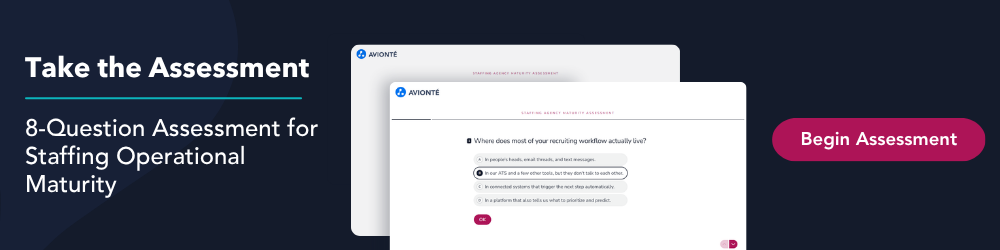
If you want to see where your agency actually sits on this curve — and what it would take to move up — let’s talk. Schedule a demo →