At a Glance
This guide covers four common staffing bottlenecks, including candidate reactivation, payroll handoff, compliance tracking, and multi-client visibility, and shows how a staffing-built platform can eliminate the workarounds that slow your team down.
Your recruiters aren’t slow. Their system is.
When a light industrial staffing agency hits a growth wall, the problem isn’t always a lack of effort. Sometimes the software makes the work harder than it needs to be.
The issue isn’t applicant tracking itself. It’s using the wrong ATS for staffing.
A general-purpose ATS, designed primarily for in-house or corporate recruiting rather than staffing agencies, is typically built for direct-hire recruiting, where one recruiter fills one requisition and the process largely ends when a candidate accepts an offer. Staffing works differently. The relationship continues through assignments, timecards, payroll, billing, compliance, and redeployment.
A staffing-built ATS is designed around that full cycle. When the system doesn’t support the way a staffing agency actually operates, recruiters must fill the gaps themselves, often with spreadsheets, manual follow-ups, and duplicate data entry.
Over time, these workarounds do more than add extra steps. They create bottlenecks at critical points in the staffing process, slowing down placements, adding work for back-office teams, and making it harder to manage talent across clients and assignments.
What Are the 4 Most Common Bottlenecks in Staffing Workflows?
Four common ATS bottlenecks emerge when software isn’t built for the full staffing lifecycle: candidate reactivation, payroll handoff, compliance tracking, and multi-client visibility.
Each develops at a point where a general-purpose ATS may stop, but the staffing process must continue. Understanding where these bottlenecks occur is the first step toward removing unnecessary work and helping your team operate more efficiently.
1. Candidate Reactivation
A general-purpose ATS can treat a completed assignment like a closed file. In staffing, that same worker may be your fastest path to the next fill.
When an assignment ends, the opportunity to redeploy that worker doesn’t end with it. But if the system doesn’t surface available, previously vetted talent when a new order comes in, recruiters may turn to job boards to fill the gap, spending time and money sourcing candidates their agency may already know.
And that cost adds up quickly. Avionté CEO Dirk Izzo explains that sourcing a new candidate and bringing them into your talent pool can cost roughly $4,700. Keeping existing talent engaged and redeploying workers between assignments can reduce that expense while helping staffing firms protect margins.
“It costs roughly $4,700 to source a new candidate and get them into your pool. If you can keep talent engaged and redeploy them instead, you do that at a much lower cost and a much better margin, which is a big return for the customer.”
Dirk IzzoCEO, Avionté
The opportunity to do better is clear in the industry data. According to Staffing Industry Analysts (SIA), 61% of temporary workers would be open to another assignment, while only 11% ruled one out. SIA also reports that top light industrial performers achieve redeployment rates of 40% to 60%, while agencies below 25% are leaving significant opportunities to reconnect with existing workers on the table.
And StaffingHub’s 2026 State of Staffing Benchmarking Report points to a related difference in sourcing strategy: 50% of growth agencies rely entirely on owned channels, such as internal databases and referrals, while 73% of flat or slow-growth agencies still list job boards among their top three sources.
The takeaway is simple: your next great candidate may already be in your database. The question is whether your ATS helps recruiters find and redeploy that person before they spend time and money looking elsewhere.
What Does a Good ATS for Staffing Do for Candidate Reactivation?
A good ATS should make it easier for recruiters to find and act on the talent they already have, rather than turning to external sources.
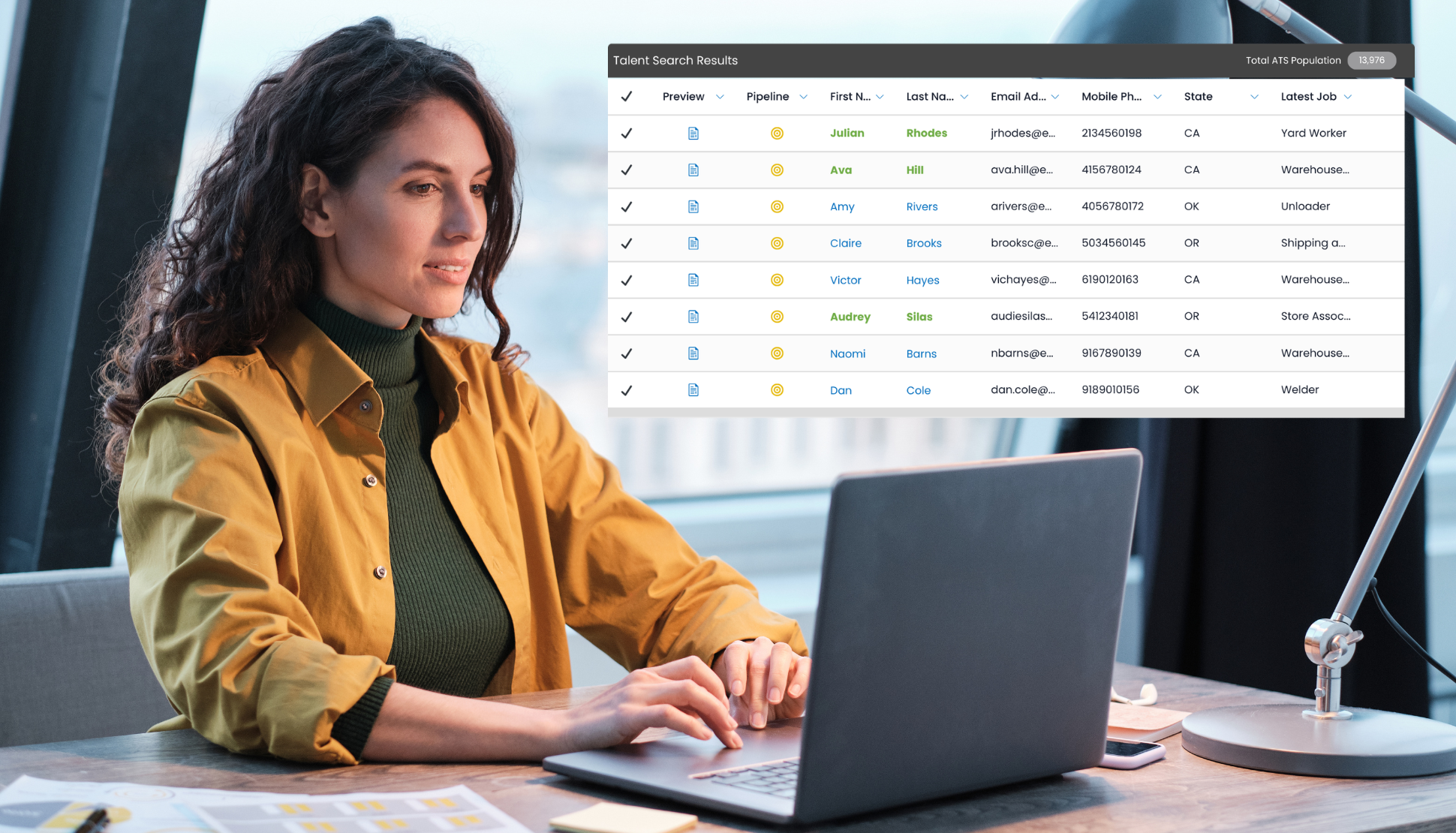
When an assignment is about to end, recruiters should be able to identify workers who are rolling off, available, and a fit for open orders. Instead of starting from scratch or posting to a job board, they can see candidates the agency already knows.
It should also help keep workers engaged between assignments. Check-ins and automated reengagement can reach workers before they start looking elsewhere, while messages remain tied to the candidate record. Workers should also be able to view matched openings, schedules, and pay right from their phones.
The payoff can extend beyond the next placement. Avionté’s Staffing Operations Report indicates that 65% of job seekers say a positive experience makes them more likely to recommend a staffing agency, while only 26% of North American job seekers report a great candidate experience.
Done well, redeployment can create the kind of experience that keeps workers coming back and gives them a reason to recommend your agency.
2. Payroll Handoff
A placement isn’t complete when a candidate accepts an offer. It’s complete when hours worked flow smoothly into payroll and client billing.
If your ATS can’t pass placement data to payroll without an export, import, or manual re-entry, your back office becomes the bottleneck every pay cycle. As headcount grows, so does the workload. In practice, this can become a recurring fire drill: pull a placement report from the ATS, reformat it to match payroll’s expectations, and manually check for discrepancies before the pay run closes.
At 50 placements a week, that’s manageable, if annoying. At 500, it can become a full-time job for someone whose actual title has nothing to do with data entry.
And the bigger risk isn’t the time. It’s the errors.
Every manual re-entry creates another opportunity for a rate, assignment code, or set of hours to be entered incorrectly. Those mistakes can show up as underpaid or overpaid workers, quickly eroding trust, or as invoice mismatches that a client’s accounts payable team catches before your team does.
Research from The Workforce Institute at Kronos found that 49% of American workers would start a new job search after just two paycheck errors. In staffing, that makes a payroll gap a retention and redeployment problem, too.
What Does a Good ATS for Staffing Do for Payroll Handoff?
A good ATS carries placement data into payroll and billing within the same system. Rates, assignment codes, and approved hours move from time capture to paycheck to invoice without any export, reformatting, or manual re-entry in between.
Discrepancies can be flagged before the pay run closes, rather than after a worker or client’s accounts payable team discovers them.
Workers can also check their hours and pay on their phones, reducing the “Where’s my pay?” calls that otherwise land on recruiters.
3. Compliance Tracking
Staffing compliance isn’t a one-time check.
Credentials expire. Certifications lapse. Requirements can vary by state and role. Many of those requirements apply to a specific placement, not just to a candidate’s profile. When a system can’t link a compliance requirement to a specific assignment, tracking often moves to a spreadsheet.
The problem is that spreadsheets are only checked when someone remembers to look. Consider a forklift certification that expires midway through an assignment. If the ATS doesn’t flag the expiration for the specific placement, the certification can lapse quietly. The agency may not find out until a client’s safety audit catches it, or worse, until an incident occurs at a site where a worker’s credential has expired.
The compliance load is growing, too.
Avionté’s Staffing Operations Report notes that pay transparency rules now cover roughly half of the U.S. workforce, more than 60 million workers, in 17 states and Washington, D.C. It also cites a July 2025 judgment of $9.3 million against a staffing agency for misclassifying more than 1,000 nurses.
A spreadsheet-based tracking system can look perfectly fine for months. Then one missed expiration becomes a liability question for your agency.
What Does a Good ATS for Staffing Do for Compliance Tracking?
A good ATS ties every credential, certification, and eligibility requirement to the specific assignment. Digital onboarding collects documents once, while the system tracks expiration dates against the placement they affect.
A staffing-built ATS helps keep compliance requirements connected to the assignments they affect. When payroll, onboarding, I-9 verification, job posting management, and placement documentation live in one platform, teams have better access to the information they need to manage requirements and maintain employment records.
As outlined in The Staffing Operations Report, this connected approach can support automated compliance checks, real-time visibility into exceptions, and faster access to audit documentation without a manual scramble.
When a client or auditor asks for proof, your team should be able to focus on providing the right records, not tracking down information scattered across systems and spreadsheets.
4. Multi-Client Visibility
Staffing agencies manage high volumes of job orders, workers, and assignments, often across multiple clients, locations, and states. As they grow, they need technology that can keep pace with changing compliance requirements and support repeat employment and redeployment.
A recruiting system designed primarily for direct-hire placements may not be equipped for the ongoing work that follows a hire. Staffing teams need to manage worker records across assignments, maintain the information required for compliance, and identify available talent when new orders come in. Without support for these connected workflows, more of the work falls to recruiters and back-office teams to track information, reconcile records, and coordinate the next assignment.
As volume grows, those manual steps become harder to manage and can slow the business down. The issue isn’t that staffing teams lack the right processes. It’s that their technology needs to support the complexity of staffing beyond the initial placement.
What Does a Good ATS for Staffing Do for Multi-Client Visibility?
A good staffing ATS gives teams better visibility into candidate activity across open orders, clients, and branches.
When recruiters can see where candidates stand across assignments, they can coordinate outreach, avoid unnecessary duplication, and identify available talent for new orders. Shared access to candidate and placement information also helps teams keep records consistent and gives leadership a clearer view of pipeline activity across the business.
Instead of piecing together updates through conversations and spreadsheets, teams can use shared information to make better decisions about where to focus next.
How Do These Bottlenecks Compound as You Scale?
Bottlenecks grow with volume, and the four can reinforce one another. A reactivation gap slows fills, a payroll gap burdens the back office, and a compliance gap adds risk. At 500 placements, workarounds that were manageable at 50 can become full-time jobs.
The cost can extend beyond daily operations, too. Griffin Financial Group’s Q1 2026 M&A research, cited in The Staffing Operations Report, found that strategic buyers and private equity firms are prioritizing firms with modern, integrated technology stacks. A fragmented tech stack can become more than an operational headache. It can become a valuation question.
What Should a Staffing-Built ATS Handle Instead?
A staffing-built ATS should support the full placement cycle in one system: surface candidates for redeployment, move placement data into payroll and billing without re-entry, tie compliance requirements to assignments, and give recruiters and leadership visibility across clients and orders.
| Bottleneck |
General-Purpose ATS |
Staffing-Built ATS |
| Candidate reactivation |
Limited visibility into available, previously vetted talent |
Surfaces candidates for redeployment and tracks referral sources |
| Payroll handoff |
Requires export, reformatting, or re-entry |
Moves hours, rates, and codes into payroll and billing without re-entry |
| Compliance tracking |
Requirements may be tracked separately from the assignment |
Ties requirements to assignments and flags upcoming expirations |
| Multi-client visibility |
Limited view across clients and orders |
Shows candidate and order status across the business |
Avionté’s ATS and CRM address all four within a single staffing platform. Front-office and back-office teams share a single database, so information doesn’t have to be rebuilt as a candidate moves from applicant to placement to redeployment.
The Bottleneck Was Never the ATS. It Was the Handoffs.
Every bottleneck in this guide occurs at a handoff. From recruiter to worker. From ATS to payroll. From one client order to the next.
When those handoffs are disconnected, your people become the connection point. They search, re-enter, reconcile, check, remember, and follow up. A platform that connects those handoffs removes the bottleneck rather than simply giving your team another way to manage it.
That’s what an end-to-end staffing platform is designed to do.
Avionté’s unified platform is built around the needs of staffing, running the front and back offices on a single database, so a placement doesn’t have to be rebuilt as it moves from applicant to paycheck to redeployment. Avionté Mobile puts job matches, schedules, onboarding, and pay on the worker’s phone, with push notifications that help keep your agency top of mind.
And that’s the real shift.
When your technology stops creating handoffs, your people stop being the integration layer.
Agencies running on a connected staffing platform stop asking how to work around their software. They start asking how many more orders they can accept.
The wrong ATS turns your recruiters into the integration layer. The right platform makes that role obsolete.
We’d be happy to walk through how your current workflow compares. Let’s talk.
Key Takeaways
- Choose a staffing-built ATS, not just any ATS. The bottlenecks in this guide come from systems designed around direct-hire recruiting. Software that models assignments, payroll, and compliance is built to handle staffing realities.
- Evaluate redeployment capabilities before you sign, not after. Look for an ATS that helps recruiters identify available, previously vetted workers who fit new orders. Matching capabilities should help prioritize the strongest candidates for each opening, rather than requiring recruiters to search manually through the database. Also, look for referral source tracking to understand which channels bring in talent that stays engaged and returns for future assignments.
- Close the payroll handoff gap early. Payroll is the bottleneck your back office feels every pay cycle. If placement data requires an export or manual re-entry to reach payroll, that workaround repeats every cycle and becomes more expensive as volume increases.
- Treat the four bottlenecks as one problem. Each gap grows with headcount. Agencies that hit a growth ceiling can find themselves limited by back-office capacity rather than sales or recruiting. A connected platform can close all four gaps in one workflow.